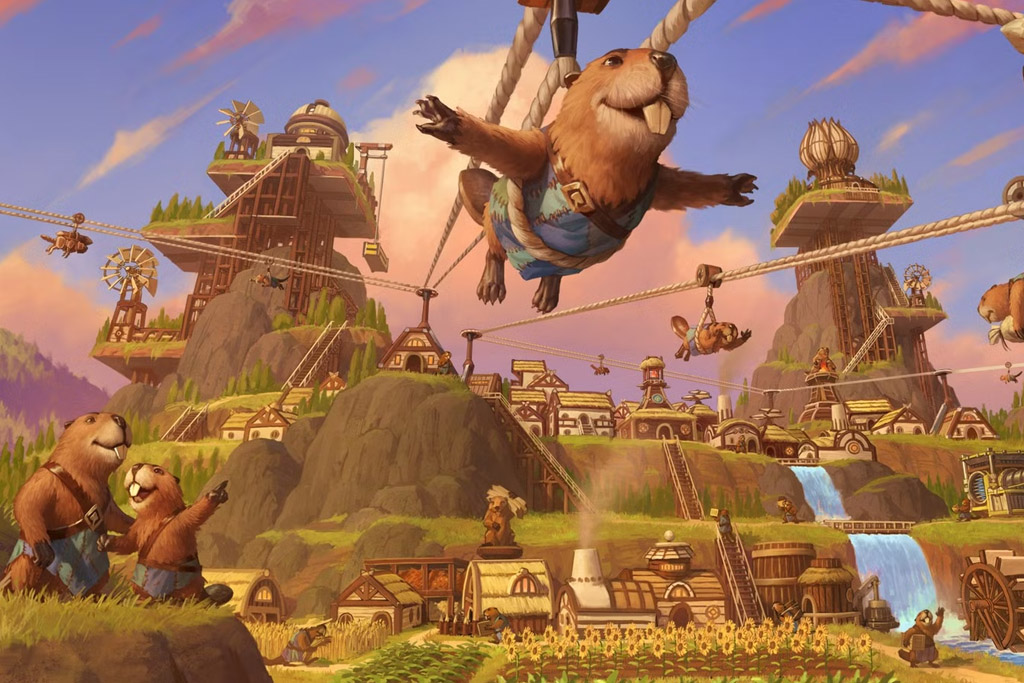
 Timberborn is a city-management survival game created by Mechanistry. In this world, humans are long gone, and you control a colony of evolved beavers. Your goal is to build a thriving sanctuary in a desolate landscape where resources are scarce, and clean water is your most precious commodity. You must balance food, water, wood, and shelter while monitoring your beavers’ well-being and population growth. Timberborn’s unique talent is vertical builds and complex water physics. Strategic terrain elevation and the way you direct the flow of rivers are central to your colony’s survival in this clever beaver builder.
Starting Your Colony
When you begin a new game, you are typically placed in a patch of green land near a water source. This is the site of your District Center, the heart of your town. Unless you are playing the tutorial, you are free to explore and expand as you see fit. However, before you can dive into advanced engineering, you must secure three necessities: a water pump, essential for extracting drinkable water from the river, a Lumberjack Flag to assign beavers to harvest nearby trees for wood, a Gatherer Flag and Farmhouse, to collect food and have an area to deposit them, and Shelter, as Beavers need homes to rest; sleeping outside negatively impacts their well-being.
As you grow your colony, you must use harvested wood and researched tech to expand, grow, and achieve new materials that you can use for more efficiency, or to reach places you thought you couldn’t. And if you need a reason to expand your colony, there, of course, lies a stronger material than wood that you can only find far from your initial colony!
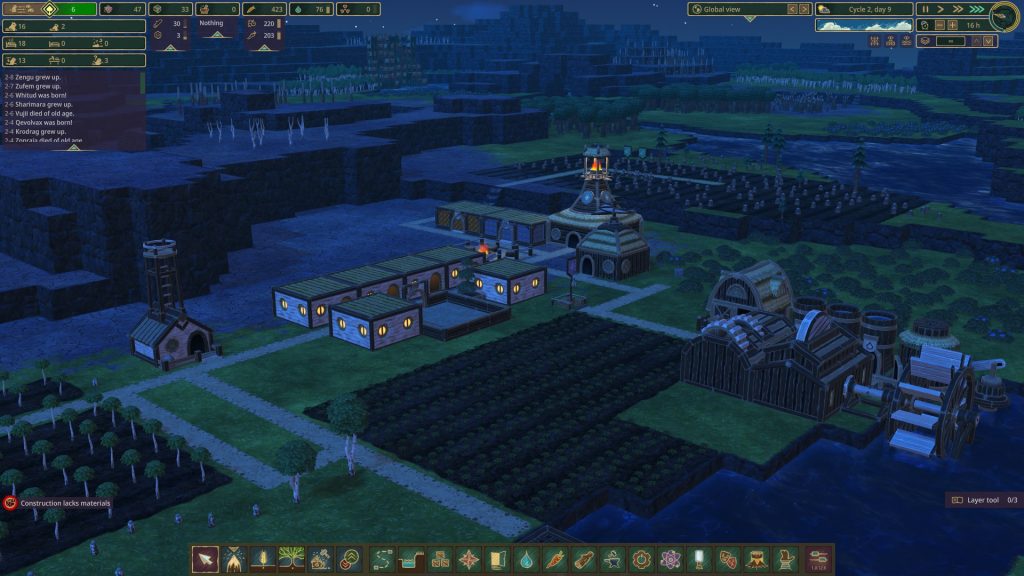
A small starter colony in Timberborn. This is what most colonies would look like at the start, plain and simple.
Surviving the Drought
The primary threat in Timberborn is the Drought. During these periods, the water sources at the edge of the map stop flowing. Without a constant supply, lakes and rivers will eventually dry up due to evaporation and pumping, causing your lush green land to turn brown and your crops to wither.
To survive, you must use and work with Water Storage and have plenty of Water Tanks and Warehouses to stockpile supplies before the dry season hits. Practice your Engineering and use Dams, Floodgates, and Levees to trap water in reservoirs, ensuring pumps keep working even when the river stops flowing, and be very wary of Badwater, an eerie, contaminated red liquid that can kill your crops and make your beavers sick. Learning to divert this away from your colony is vital for long-term survival.
Research and Advancement
As your colony stabilizes, you will need to provide more than just the basics. Beavers crave entertainment, spirituality, and advanced nutrition. To unlock the structures required for these needs, you must generate Science Points.
You should build an Inventor hut as soon as your basic survival is secured. Science Points allow you to unlock advanced technology like gear workshops, paper mills, and massive metal structures. This game is a marathon, not a sprint; expanding too quickly without the tech to support your population can lead to a sudden colony collapse. If you don’t want to risk collapse, take full care of every single system available: resources, Beaver health, water, food, engineering, science, anything and everything.
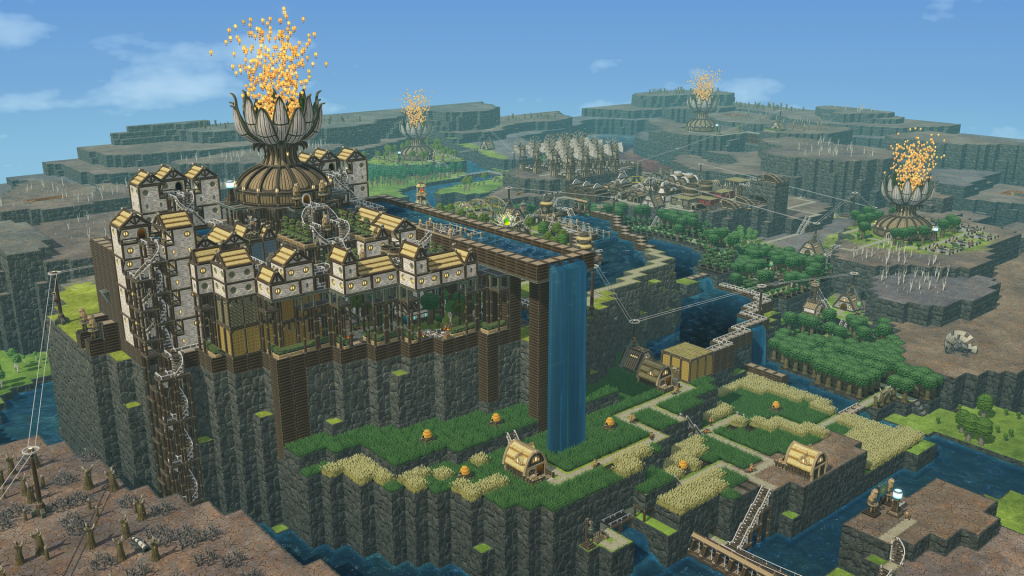 A megabuilding, and a showcase of just what you can make in this game! Image provided by Mechanistry.
Unique Mechanics and Factions
Timberborn offers a unique experience because it is almost entirely wood-based. Unlike traditional city builders, where you might buy a solution, here you must physically harvest every log and manufacture every plank. The game also features two distinct factions, the Folktails and Ironteeth. The Folktails are expert farmers who respect nature and use wind power, whilst the Ironteeth are industrial masters who use engines and vertical deep water pumps.
As your civilization grows, you can establish multiple District Centers to manage different areas of the map, allowing you to maximize productivity across vast distances. While you can use the 2x or 3x speed options to pass the time, every building and dam must be carefully planned. The transition from a small riverside camp to a massive, multi-tiered engineered civilization is incredibly rewarding. Take your time, experiment with the water physics, and see how long your colony can endure!
Automation and New Frontiers in Timberborn 1.0
With the highly anticipated 1.0 release, the world of Timberborn has expanded beyond log-piling. The most significant addition is a robust Automation system, introducing over twenty new buildings like sensors, logic relays, and timers. These tools allow you to program your colony’s infrastructure—such as setting floodgates to close automatically when a badtide is detected or toggling industrial machinery based on your current power surplus. The update also introduces Unconventional Maps that feature unique environmental hazards like Unstable Cores, dormant human remnants that can detonate if not managed, and Geothermal Fields that provide a powerful new source of renewable energy. These additions transform the late-game into a complex mechanical puzzle, giving you more ways than ever to ensure your beaver civilization stands the test of time.
Personal Synopsis
Timberborn is a fun game to play to pass the time. This game fits right between town-builders like SimCity or factory games like Factorio. The game is low-stress, but requires precision and problem-solving in order for your town to succeed. It is definitely one of the better, more high-quality town-builders I have played. I love the art style and beaver theme which add whimsy to an otherwise serious genre of gaming. I do not wish to spoil any of the later gameplay for the audience, it’s really a thing you must explore yourself!