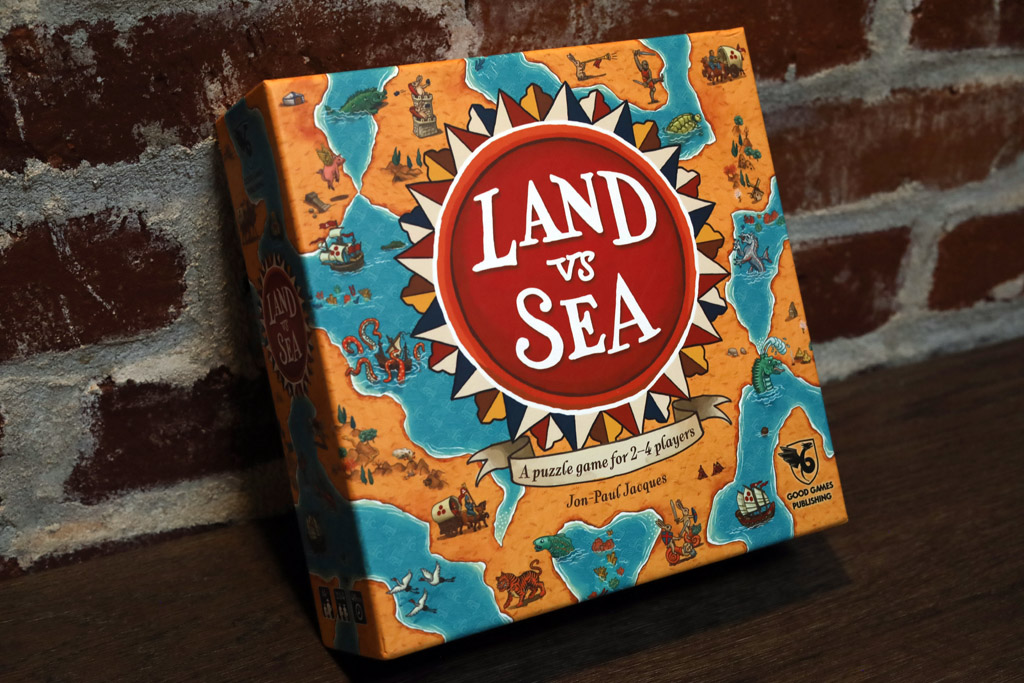
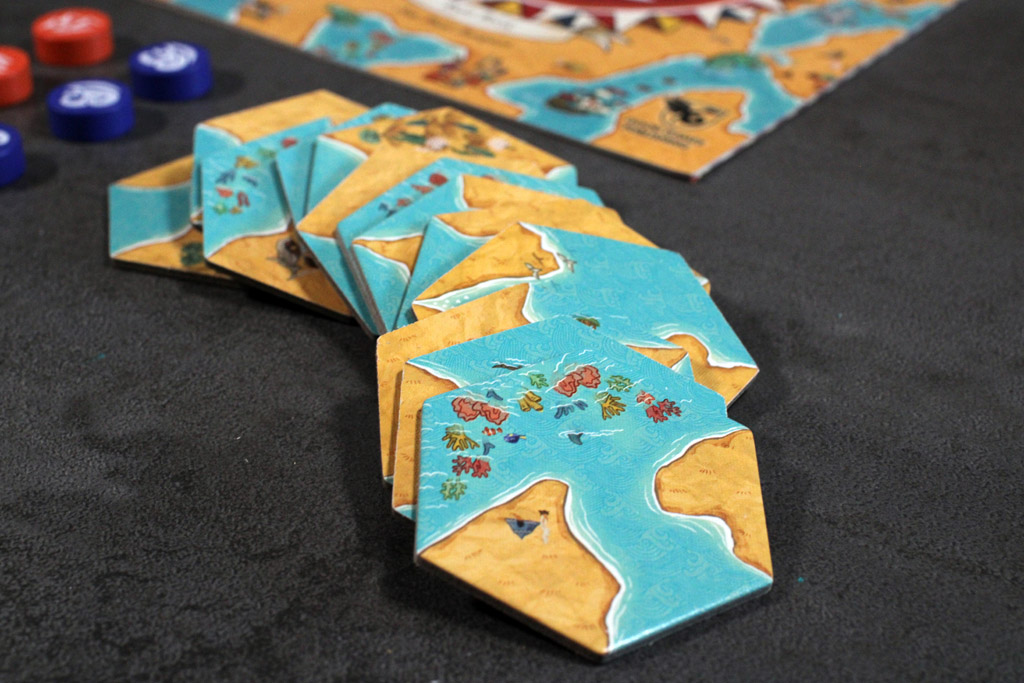
Land vs Sea is a cartography-themed tile-laying game from Australian designer-artist Jon-Paul Jacques, published by Good Games Publishing. Two players (or teams) build a single shared map from double-sided hex tiles, closing off land and sea regions for points while jockeying for bonus icons trapped inside those borders. The hook sits in the components: each tile has a public face and a hidden reverse that only its owner can see until it hits the table.
Good Games Publishing pitches it as “only 2 minutes to learn,” with optional scoring layers that raise the ceiling without bloating the teach. Your core decision never changes—place one tile so land edges touch land and sea touches sea—but the game keeps asking a sharper follow-up: whose score did you just build?
What’s in the box
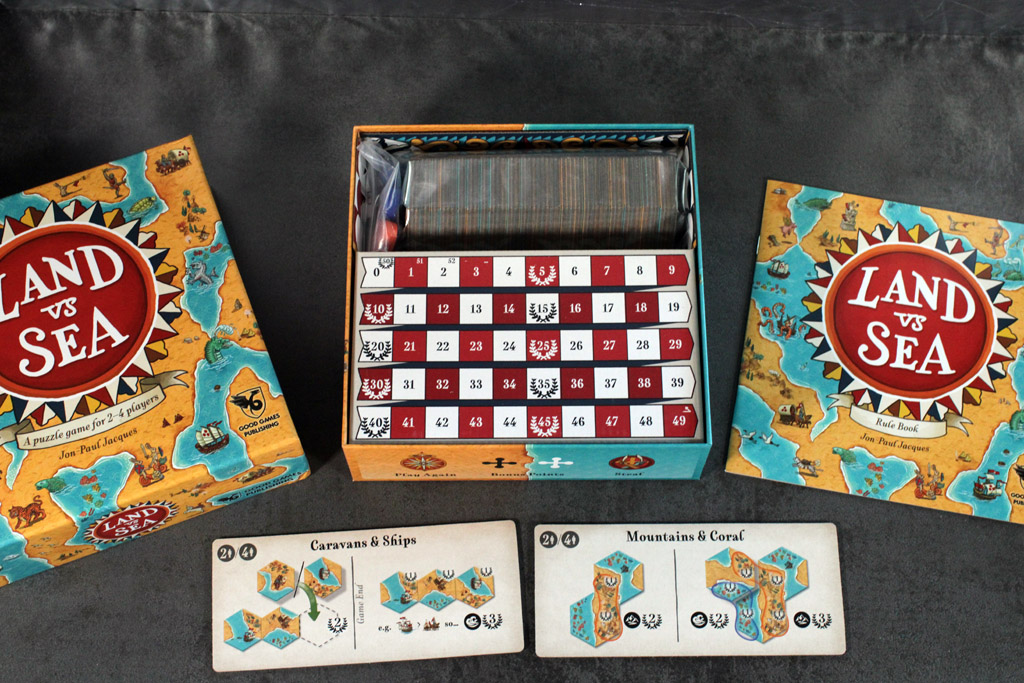
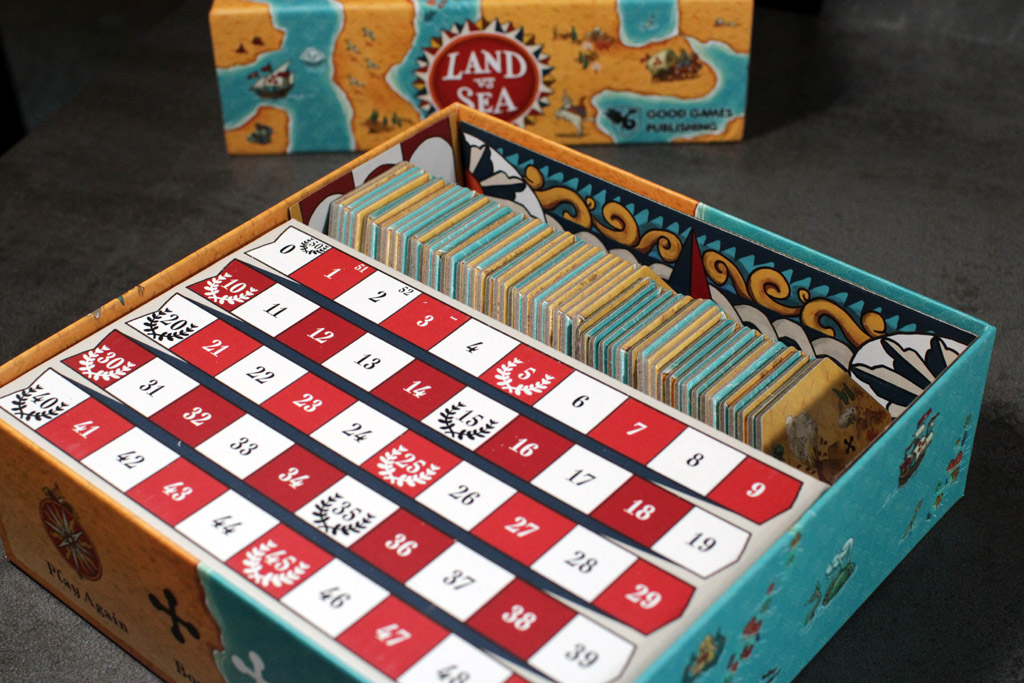
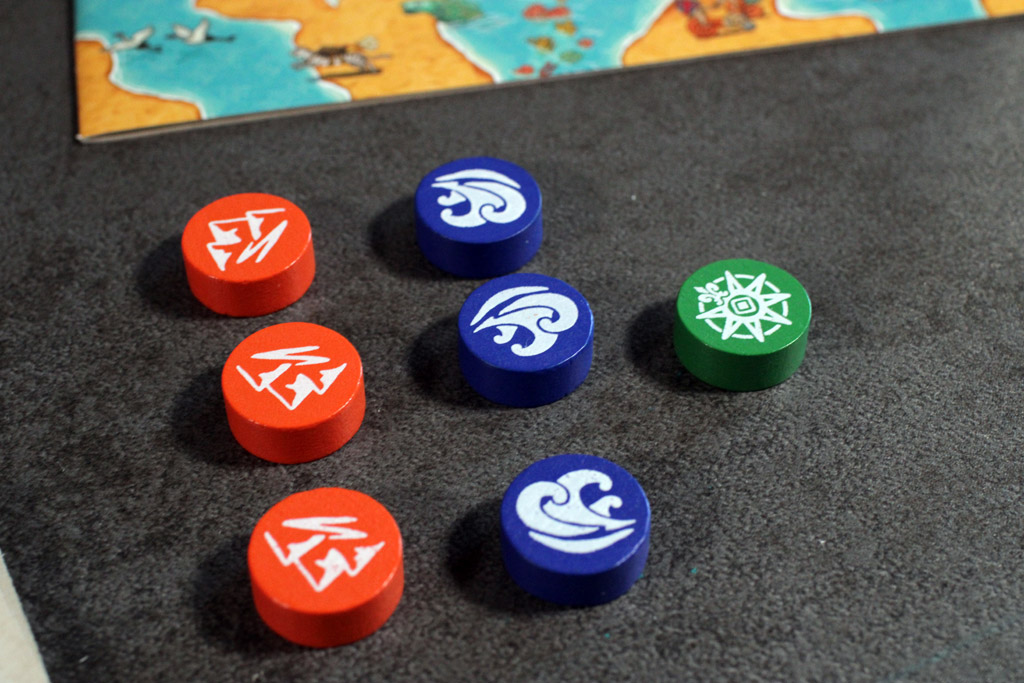
Land vs Sea keeps its footprint tight: a starting map tile, a Volcano/Whirlpool plug tile for rare holes, 58 double-sided map tiles, two double-sided scoring-aid player mats, and seven wooden discs (Land, Sea, and the Cartographer token for 3-player). The scoreboard on the insert makes scorekeeping feel like part of the artifact. You build a medieval-looking map and track points inside the box that came with it.
How the Game Plays
-
Choose roles and set the table: Randomly assign Land and Sea (and in 3-player, add the Cartographer). Put the starting tile in the center and set the box bottom within reach as the scoreboard.
-
Build two draw stacks: Shuffle the map tiles and split them into two stacks. Players draft and replenish from the top of either stack.
-
Draft your starting hand: Starting with Land, players take turns choosing a tile from either stack until everyone has two tiles. You can look at your tile’s hidden reverse after you take it, but you cannot reveal it to others.
-
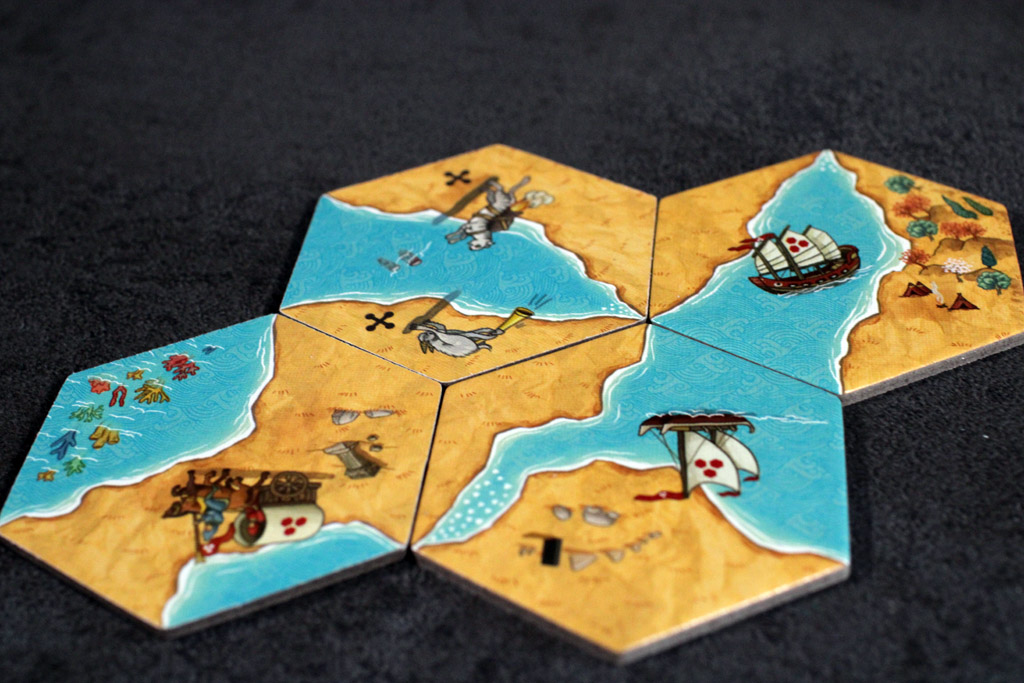
On your turn, place a tile: Look at both sides of your two tiles privately. Pick one tile and one face to play. Place it adjacent to the existing map so every touching edge matches: land-to-land, sea-to-sea.
-
Resolve action icons: Some tiles show Play Again or Steal icons. Play Again lets you immediately place your second tile. Steal lets you take one tile from an opponent who has two tiles. Unlike some other games, you can play a stolen tile on the same turn.
-
Score completed regions: A region scores when it is fully enclosed. Land scores 1 point per tile in completed land regions; Sea scores 1 point per tile in completed sea regions. Crucially, the player who completes the region (the “Closer”) takes the bonus points inside it: 1 point per bonus icon enclosed, regardless of their faction.
-
Optional: Waypoints and Replenish: After scoring, you may place a Waypoint (if using that module), then draw from either stack until you have two tiles.
-
End the game: The game ends when the last tile is placed. Highest score wins; ties remain ties.
Scoring layers that change the texture
The base game already creates clean tension, but Land vs Sea’s optional modules lean into deeper strategy:
-
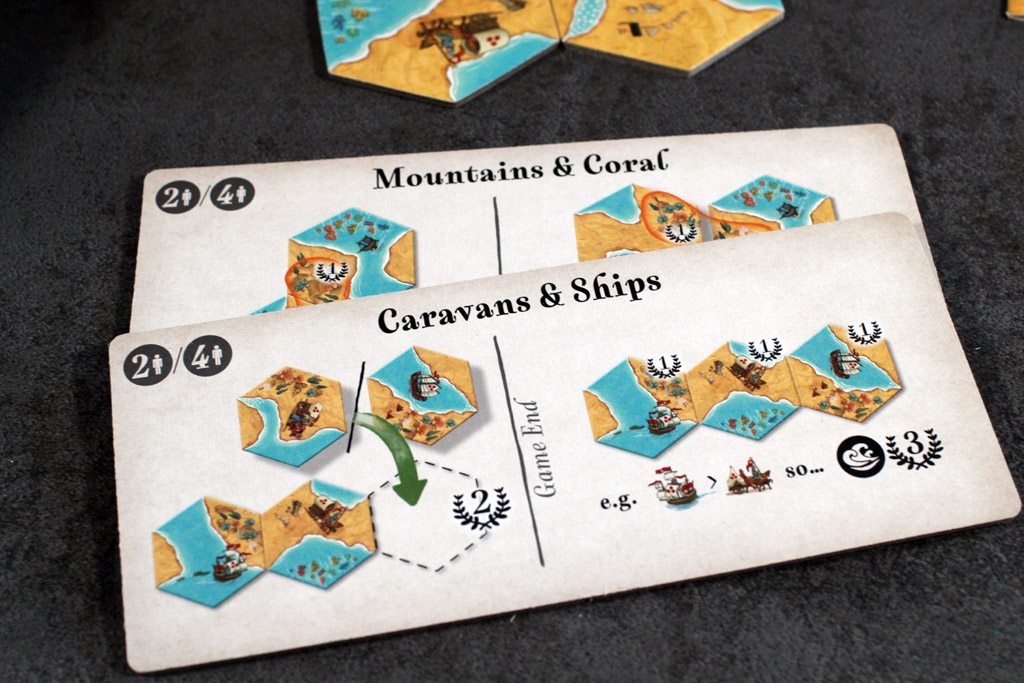
Mountains & Coral: Some edges include Mountain or Coral sections. When a player connects Mountain-to-Mountain or Coral-to-Coral, that player immediately scores 1 point per section in the resulting chain.
-
Caravans & Ships: Placing a Caravan/Ship tile adjacent to another of its kind scores 2 points immediately. At game end, the player with the majority of their icons in a “Trade Route” cluster scores 1 point per tile in that route.
-
Waypoints: You place these on open segments of your own faction. When a region containing a Waypoint is completed, the owner of the Waypoint scores 1 bonus point.
Three Player Counts, Three Different Conversations
-
2 Players (The Clean Duel): The purest way to play. You learn how often it’s correct to finish your opponent’s region just to steal the bonus icons inside.
-
3 Players (Asymmetric Cartographer): The Cartographer is a “chaos” role. They score points when either Land or Sea regions are completed, but only for the bonus icons inside them. They also score for Mountain/Coral connections and score Trade Routes only if Caravans and Ships are tied.
-
4 Players (Teams): Teammates share a score but cannot use “words, gestures, or body language” to give advice. They must use Waypoints to signal intent.
Beginner tips for Land vs Sea
-
-
Chase closures, not empires: Aim for many small areas. Large regions carry high risk because unfinished regions score zero points at the end of the game.
-
Finish their region when the bonus is worth it: Land/Sea points go to the faction, but bonus icons go to the closer. It is often worth giving your opponent 3 points if it nets you 4 bonus points.
-
Use Steal to deny certainty: Steal works best as disruption: yank a tile from an opponent’s hand right before they can use it to finish a massive project.
-
Don’t fear the Volcano/Whirlpool: If a six-sided “hole” forms, the player who completes the ring must fill it with this special tile. It is a powerful tool for swinging bonus point totals late in the game.
-
Where it sits among tile-layers
Land vs Sea shares DNA with classics like Carcassonne, but the two-sided hidden information makes planning feel unique. You read the top of everyone’s tiles like public posture and treat the unseen side like private leverage. It turns a simple “matching” game into a game of soft negotiation and tactical secrets
Land vs Sea at a glance
Designer / Artist: Jon-Paul Jacques
Publisher: Good Games Publishing
Retail release: October 2021
Players: 2–4
Time: ~40 minutes
Age: 8+
MSRP (USA): ~$29.99
Notable extras: Official rules PDF, Tabletop Simulator support, and a Watch It Played tutorial by Rodney Smith.