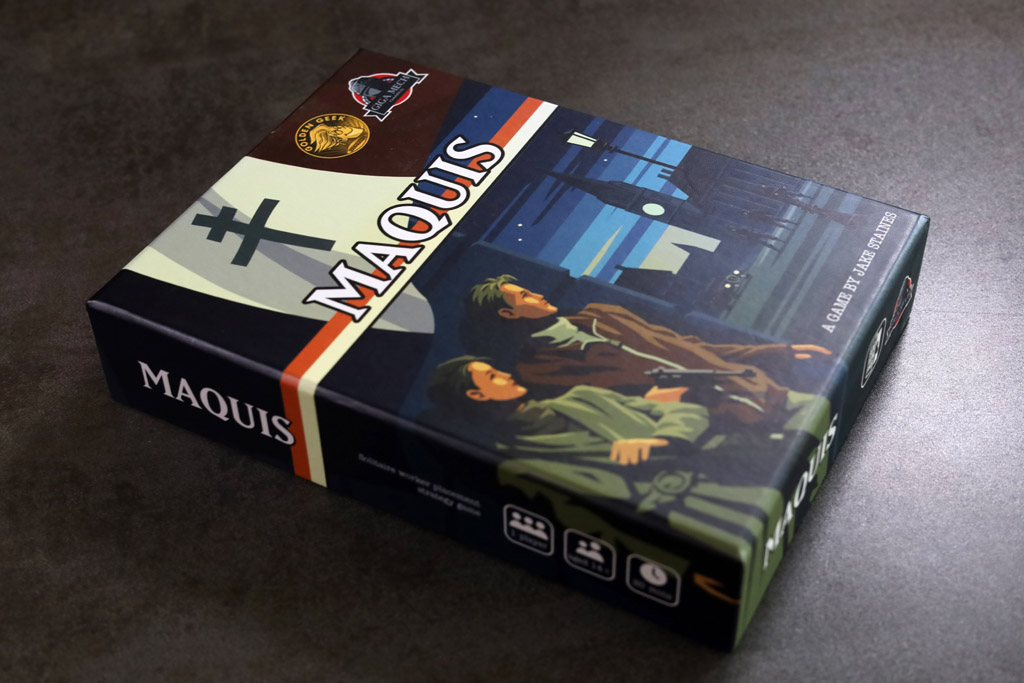
Maquis is an elegant 20-minute worker-placement game about staying alive long enough to win. The game is designed as a solo experience that puts you in charge of a French Resistance cell in World War II, operating inside an occupied town where every action risks an arrest. Designer Jake Staines first released it as a print-and-play title in 2013, where it became a standout in BoardGameGeek’s Solitaire Print and Play Design Contest scene. Side Room Games later published a boxed edition in 2019, then expanded it with a 2nd Edition that adds new missions and resources while keeping the core structure intact.
Staines described the project as a design test: “Maquis came from a personal challenge,” he said in an interview tied to the solo contest circuit, citing his love of worker-placement games and the push to adapt that feel to solitaire play.
What you actually do in Maquis
Each game gives you 15 days to complete two missions before the occupation breaks the morale of your network or the calendar runs out. Missions ask for concrete acts of sabotage and logistics—deliver weapons, plant explosives, publish propaganda, move supplies through town—tasks that read like errands until patrols start sealing streets.
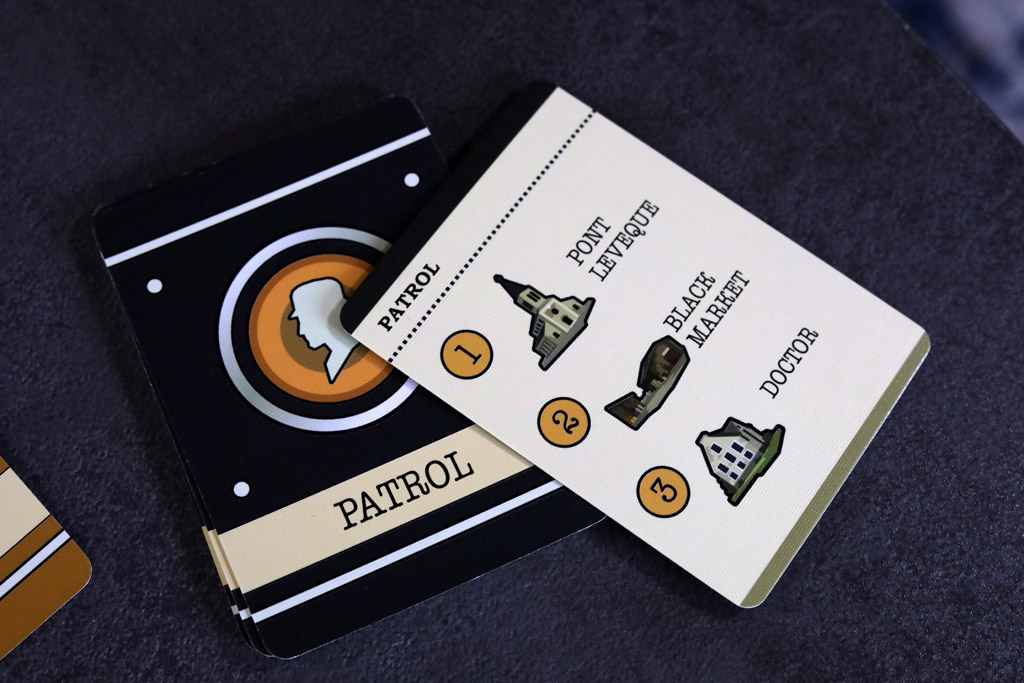
The key mechanical idea: you and the occupation alternate placing workers and patrols (worker first), with patrols drawn and positioned from a deck of cards. When your workers finish an action, they still need a safe route home. A worker who can’t trace a clear path back to a safe house gets arrested and leaves the game for good.
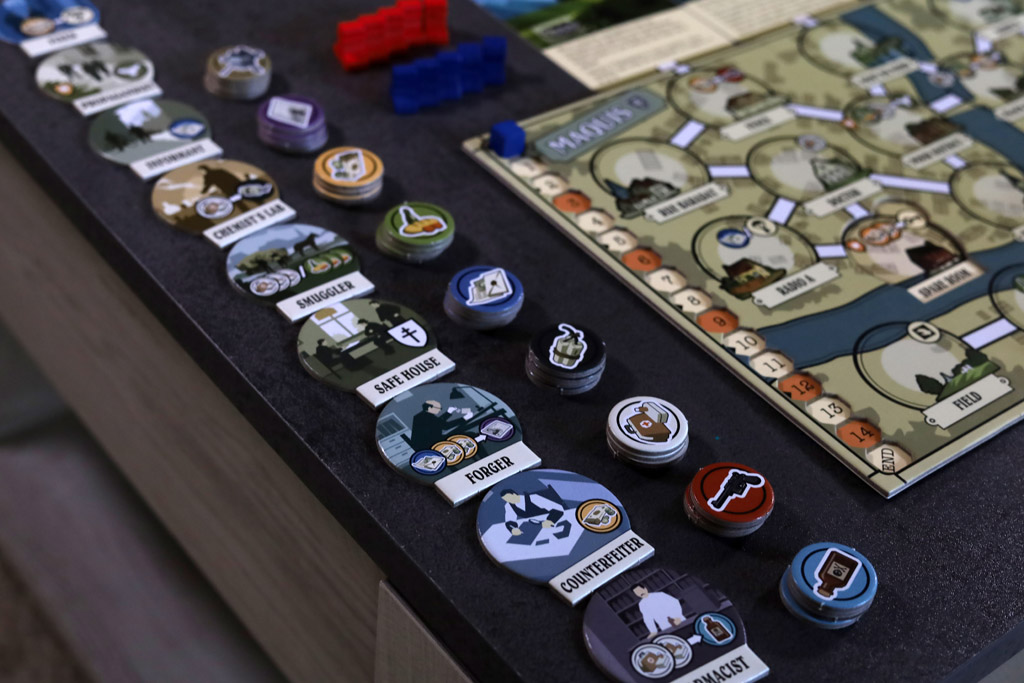
Components and table presence
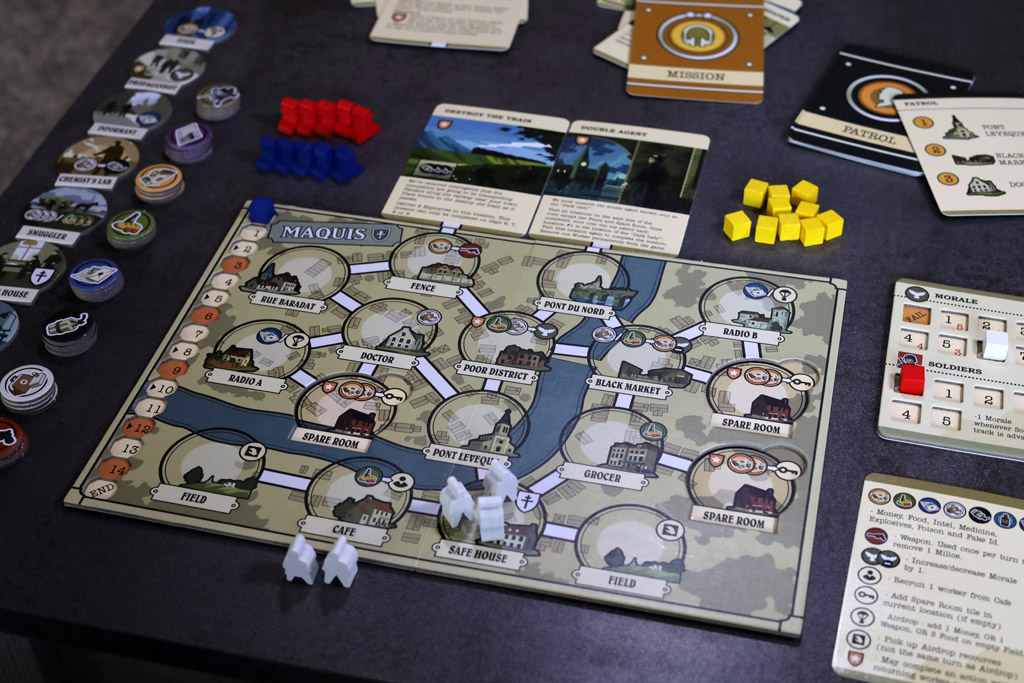
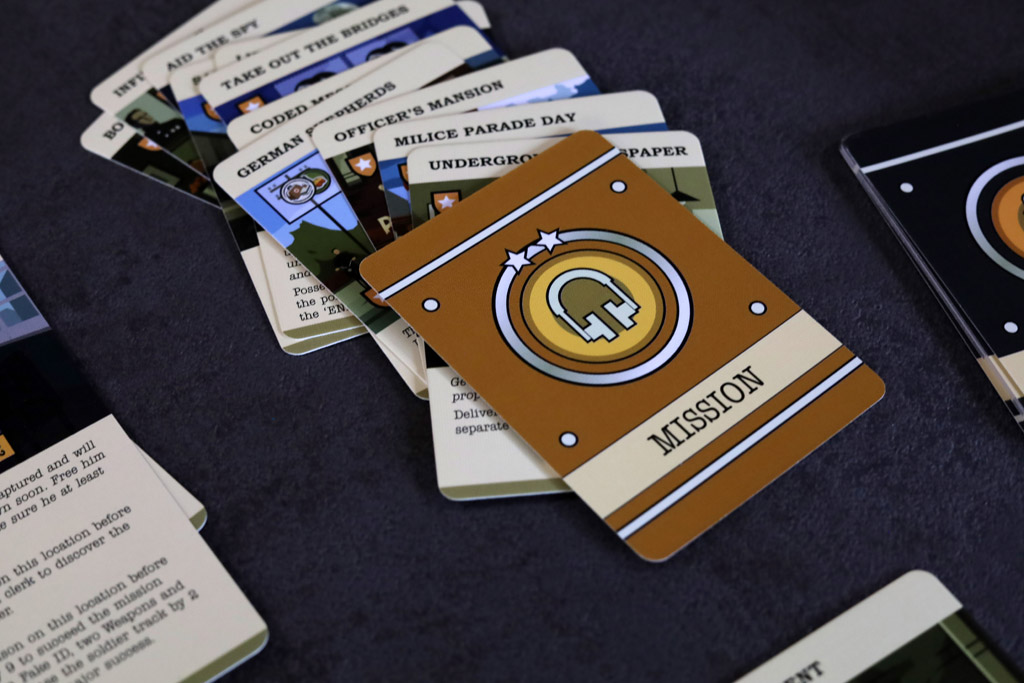
The rulebook lists a compact set of parts: a main board, five Resistance worker pawns, Milice and Soldier patrol pawns, patrol cards, mission cards across multiple difficulty tiers, resource tokens (money, weapons, explosives, intel, medicine, food, poison, fake IDs), spare-room tiles that permanently alter locations, and a separate morale/conflict track. Credits in the 2019 rulebook name Jake Staines as designer and credit Ilya Baranovsky and Mark Tuck for artwork and iconography.
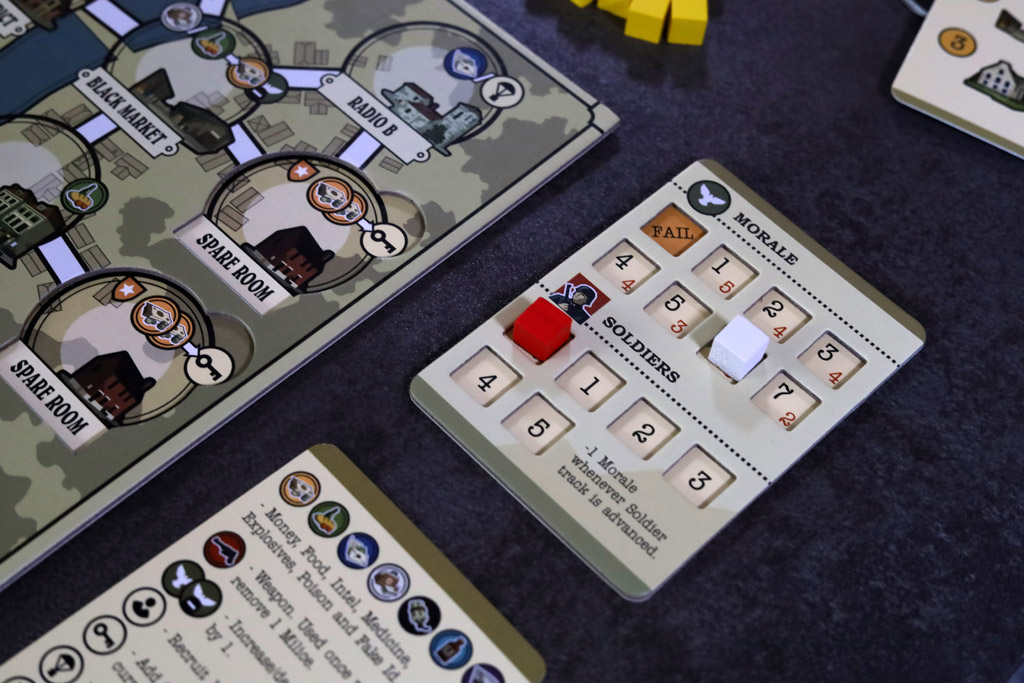
How a day works
Each in-game day runs in three phases: Placement, Action, Upkeep.
Placement phase
You first check morale to determine how many patrol pawns enter town.
The game sets patrol count as the higher of: (1) your recruited, available workers, or (2) the red “minimum patrols” value on the current morale space.
You and the occupation alternate placing workers and patrols one at a time (you first), revealing patrol cards one by one to position the occupation pawns.
Action phase
You activate your workers in any order, one action each.
After a worker acts, you must trace an escape route along roads back to a safe house, using only empty spaces or spaces with other Resistance workers. Patrols block that route.
Upkeep phase
You clear patrols off the board and advance the day marker.
That cadence creates the game’s signature pressure: placement looks generous, then escape math turns every street into a liability.
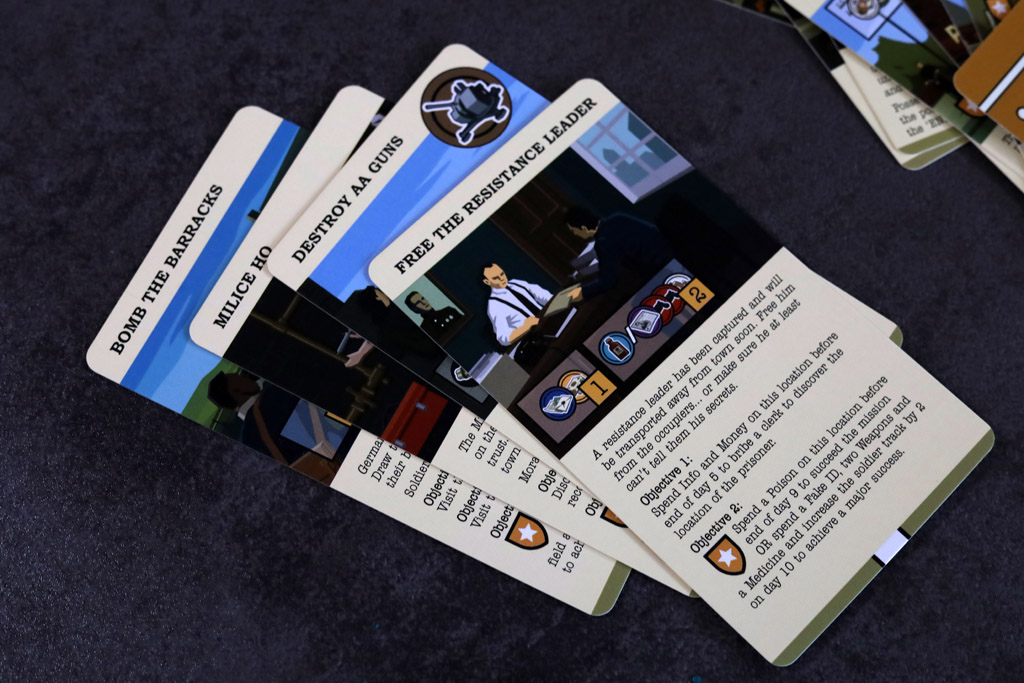
Step-by-step For New Players
Set up the boards and tracks. Put the day, morale, and conflict cubes on their start spaces. Shuffle the 10 patrol cards into a face-down deck.
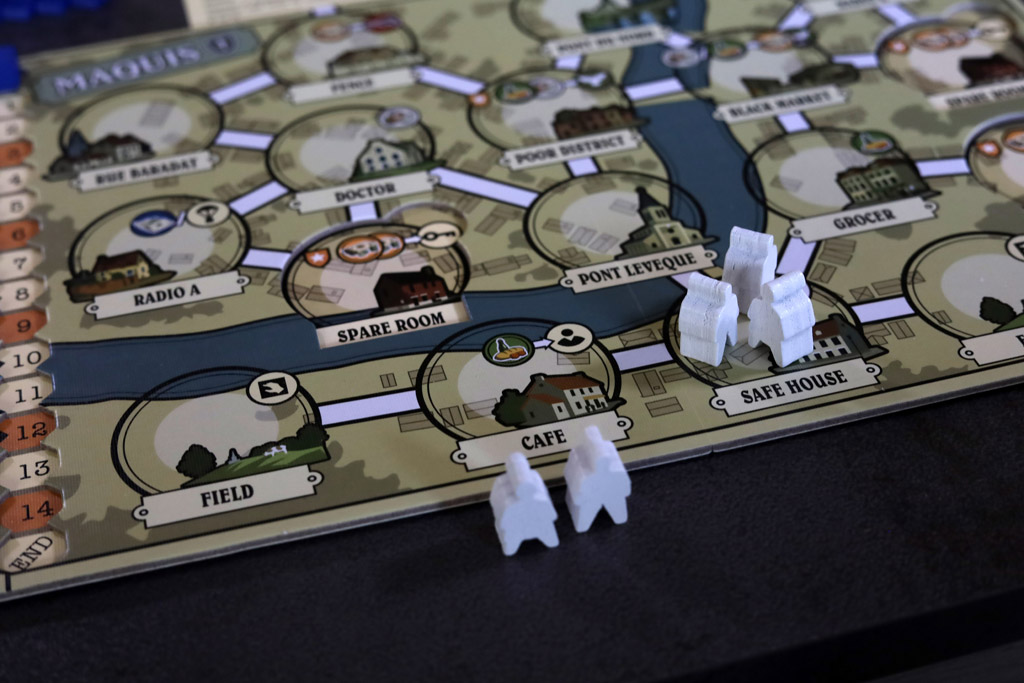
Build your starting cell. Place three workers in the Safe House and keep two by the Café for later recruitment.
Choose two missions. Use easier missions for a first game, then mix in higher-star missions once you know the map.
Start Day 1 with placement. Place all available workers, then draw patrol cards until the required number of patrols are on the board.
Take actions with your workers. Collect resources, trigger location powers, work on mission rectangles, recruit, airdrop supplies—each worker gets one action.
Get everyone home. After each activation, trace a legal route back to a safe house. If the route fails, the worker gets arrested and leaves the game.
Handle patrol logic correctly. When you draw a patrol card, it lists three candidate locations. The patrol takes the first open location; if all three are filled by your workers, the patrol performs an arrest at the first location listed on the card.
Use tools sparingly. A Fake ID can bypass a single patrol on the way home; you spend it only when you use it. Discarding a Weapon can remove one Milice pawn once per day, but that shot increases the conflict track and can cost morale.
Advance the day. Clear patrols and move the day marker. Morale is usually lost when workers are arrested or when conflict escalates too high.
End the game on the rulebook’s terms. You win immediately when you complete both missions. If you fail to complete both before the day track ends or morale hits zero, you lose the game.
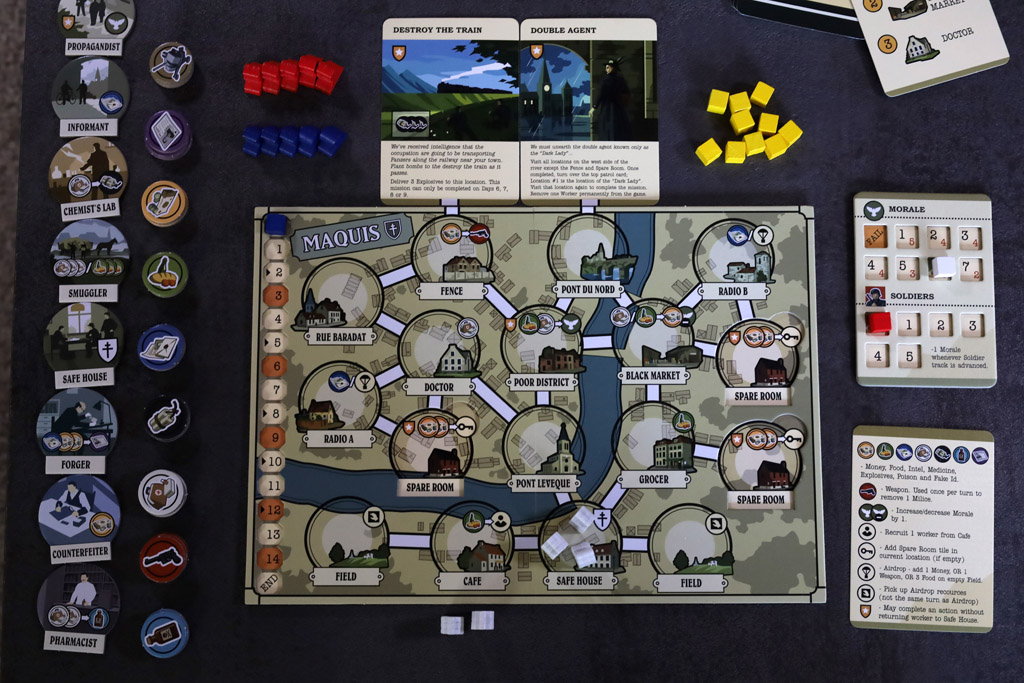
Why Maquis stands out in solo design
Most solo worker-placement games solve “the other players” with a deck and some blocking. Maquis turns blocking into the story engine. You can place a worker anywhere, but the game asks you to plan the return trip with the same care you give the action itself. That single rule makes the board feel hostile in a way that fits the setting.
Staines also framed the theme with unusual directness for a small strategy game.“Thematically, the game places you as the leader of a French Resistance cell in the Second World War,” he said during the contest run, emphasizing clear objectives over open-ended narrative.
Similar games, and what Maquis does differently
If you like solo tension puzzles such as Under Falling Skies, you’ll recognize the feeling of a plan collapsing under a moving threat. Maquis builds that threat out of geography and escape routes, so your “engine” never stabilizes. The town map stays small; the decisions stay sharp.
If you want another solo title from Side Room Games with a very different shape, Black Sonata leans into deduction and hidden movement. Maquis keeps its focus on operational logistics: place, act, run, repeat.
About Side Room Games
Side Room Games was founded in 2017 by a group of passionate gamers—Dustin, Michael, Alan, and Brett—who transitioned from backgrounds in software engineering and professional tech to follow a mission of bringing exceptional community designs to life. The company has carved out a distinct niche by specializing in small-footprint, high-tension solo games that often begin as standouts in the BoardGameGeek Print-and-Play (PnP) community. Their catalog is defined by an “insider-outsider” perspective that prioritizes elegant, tightly integrated mechanics over sprawling complexity.
While they have expanded into multiplayer titles like Elements of the Gods, the publisher remains the industry gold standard for solitaire experiences that feel like “big box” strategy games condensed into travel-friendly packages.
| Side Room Titles | Genre / Mechanic | Player Count |
| Black Sonata | Hidden movement and deduction (historical theme) | Solo |
| Orchard / Grove / Forage | The “9-card” tile-laying and harvesting trilogy | Solo |
| For Northwood! | Solo trick-taking and diplomacy | Solo |
| Mechanical Beast | Tile-laying and puzzle-solving (manipulating a giant robot) | 1–4 Players |
| Elements of the Gods | Area control and resource management | 1–4 Players |
| Village Builder | Engine-building and spatial layout | Solo (with 2p variant) |