A Dialogue With Its Own Future
The Cyberpunk role-playing game has always existed in dialogue with its own future. Mike Pondsmith’s original tabletop designs imagined a world of privatized violence and personal augmentation decades before those ideas became fixtures of popular science fiction. What began in the late 1980s as a tabletop role-playing game became a large-scale video game in Cyberpunk 2077, and then a television series in Cyberpunk: Edgerunners released on Netflix in 2022. Each adaptation fed material back into the shared setting of Night City.
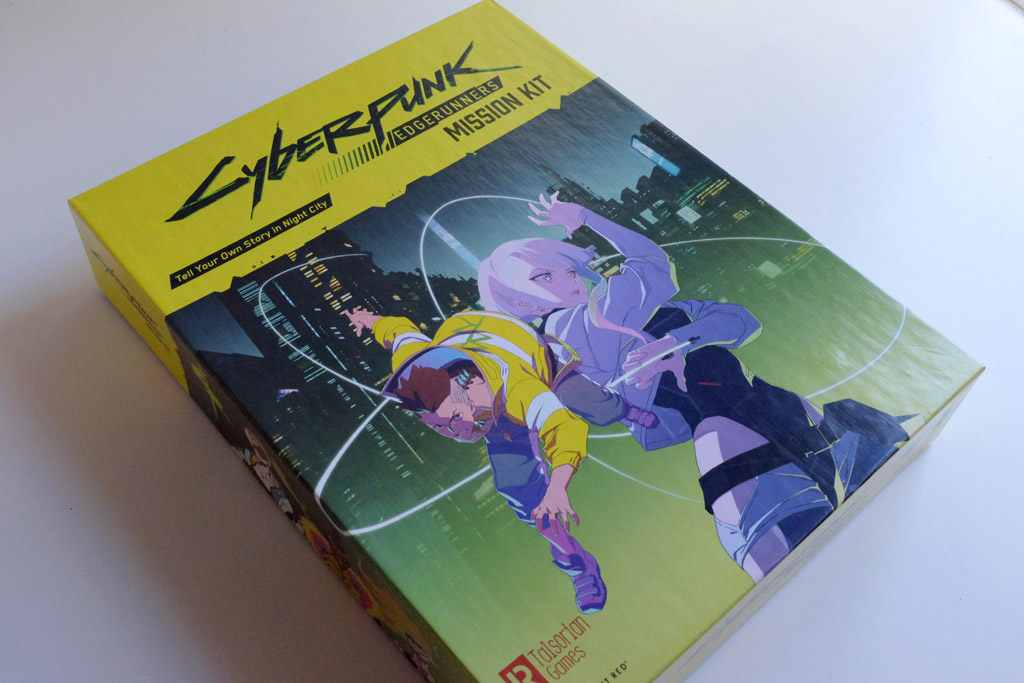
The Cyberpunk: Edgerunners Mission Kit, released by R. Talsorian Games in collaboration with CD Projekt Red, represents a return movement—an attempt to pull players back to the table, using the anime Cyberpunk: Edgerunners as both entry point and historical marker. The Mission Kit is not a new edition of the Cyberpunk tabletop role-playing game, nor is it a replacement for Cyberpunk RED, the current core ruleset. It is a boxed introductory product: a contained scenario, a simplified rules framework, and a curated set of materials intended to make Night City playable with minimal preparation.
Cyberpunk Edgerunners Mission Kit Contents
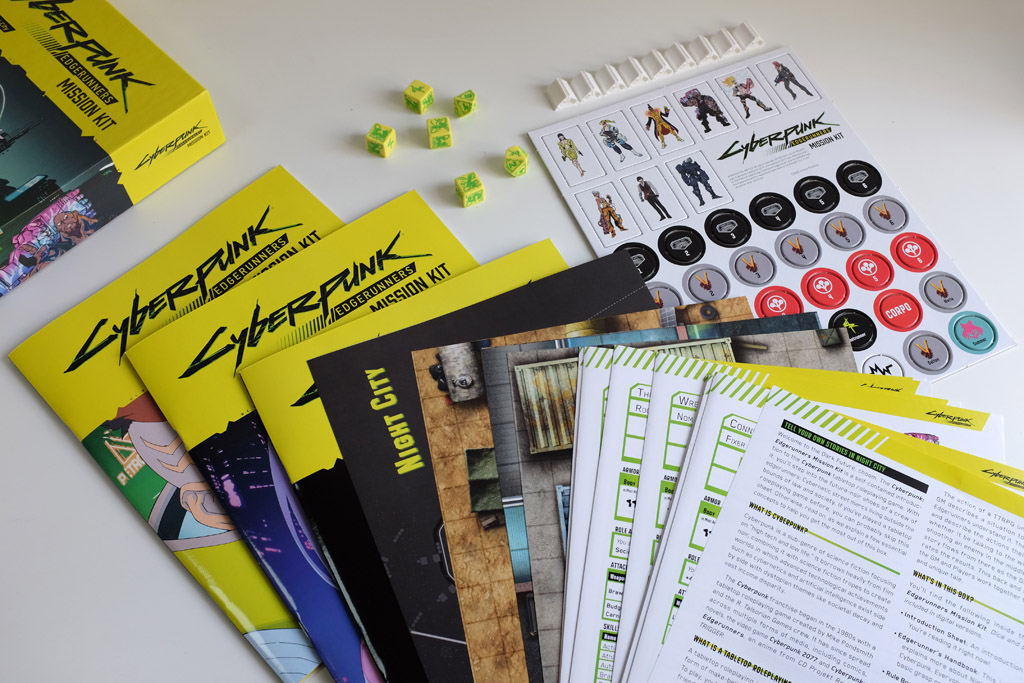
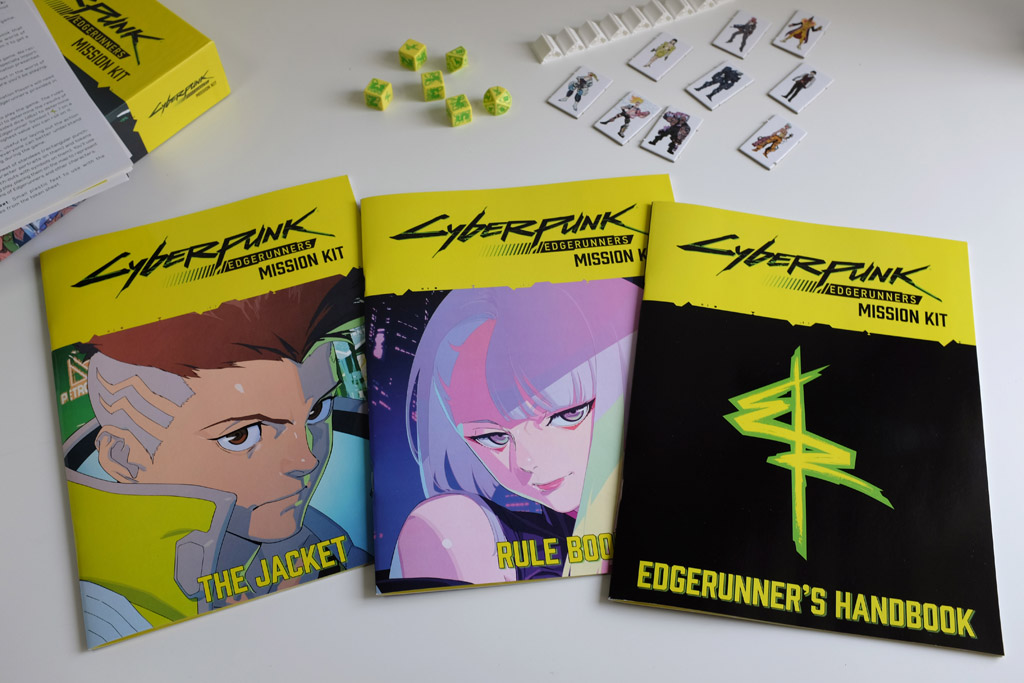
Inside the box are three softcover booklets. One serves as a rules reference, extracting the essential mechanics of Cyberpunk RED—attribute checks, skill use, combat resolution, damage, armor, and basic netrunning—without reproducing the full scope of the core rulebook. Another provides lore material tied directly to the Edgerunners anime, including character background written by Bartosz Sztybor, the series’ lead writer. The third booklet contains a complete adventure titled The Jacket, designed to be run with the included characters and materials.
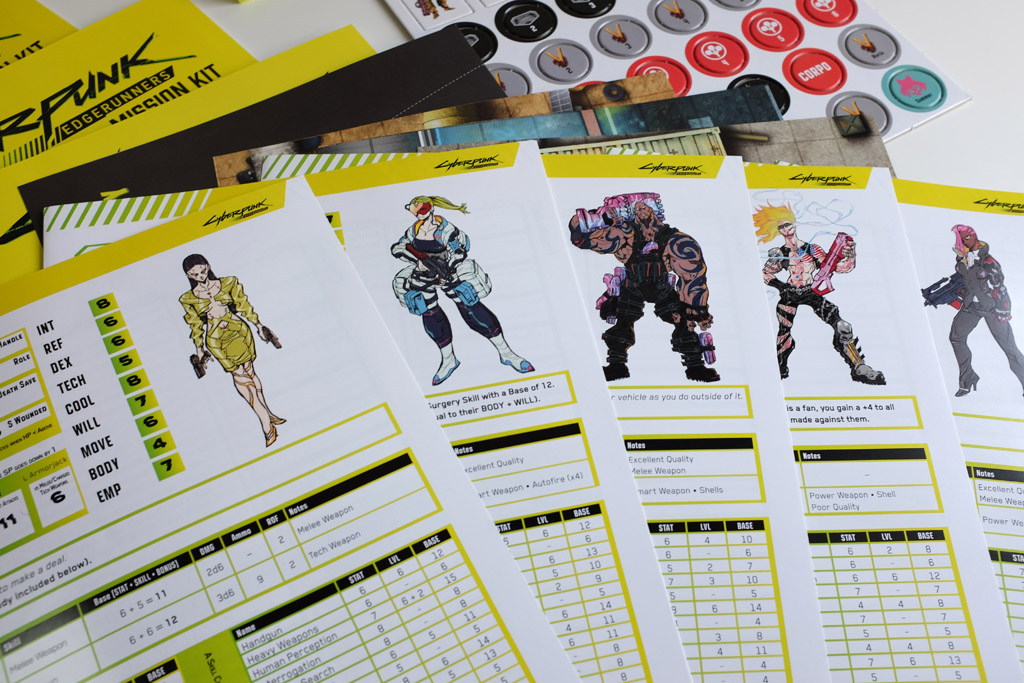
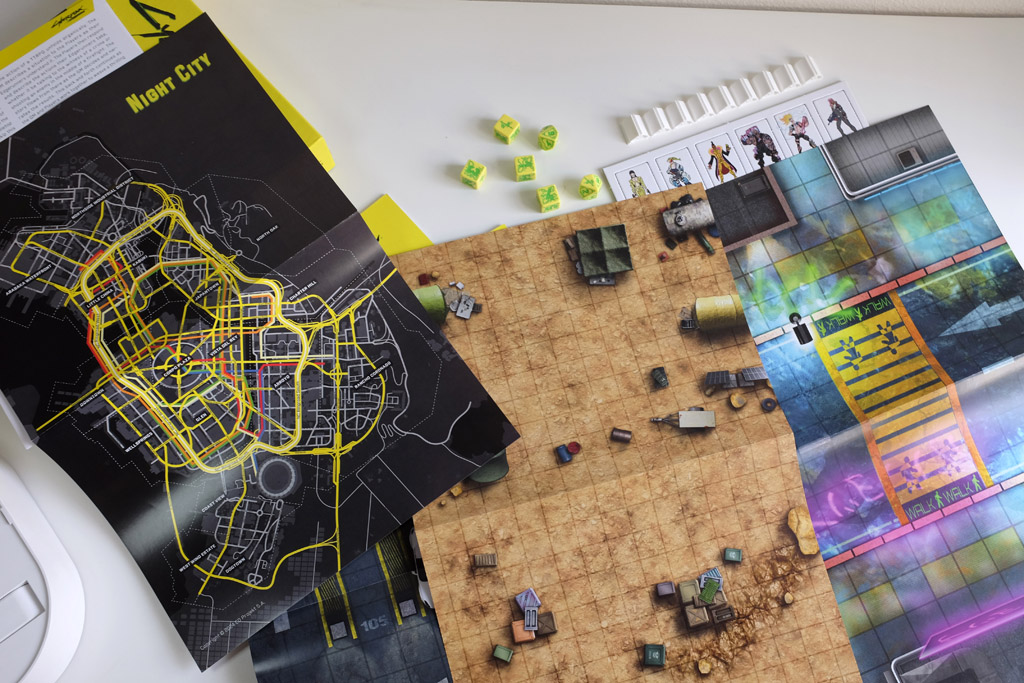
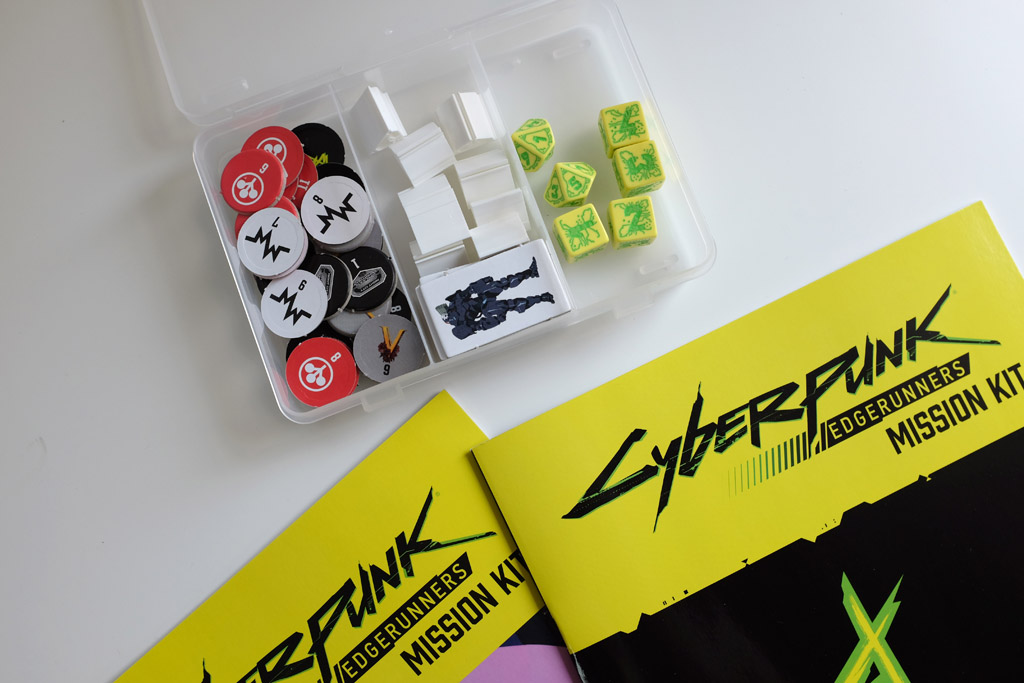
Physical components round out the set. Seven pre-generated player characters are provided, each illustrated in a style consistent with the anime’s visual language and approved by Studio TRIGGER staff. Dice are included—two ten-sided and four six-sided—along with maps, standees, and tokens to represent locations, characters, and combat positions. The intent is clear: the box should function without requiring outside purchases, at least for its contained scenario.
Edgerunners Gameplay
Play in the Mission Kit follows the structure of Cyberpunk RED, which itself is a mechanical descendant of Cyberpunk 2020. Characters attempt actions by rolling a ten-sided die and adding an attribute and relevant skill, comparing the result against a difficulty value. Combat uses the “Friday Night Firefight” system, emphasizing lethality, cover, and equipment over heroic durability. Armor degrades, bullets matter, and retreat is often a rational choice.
The Mission Kit introduces cyberware and quickhacking in a limited but functional form. Players can interact with networked devices and implanted technology using streamlined netrunning rules adapted for fast play. These systems reflect the 2070s technological landscape established by Cyberpunk 2077 and Edgerunners, but they are not exhaustive. Many advanced options found in the Cyberpunk RED core rulebook are intentionally absent. The emphasis is on clarity and pace rather than mechanical completeness.
Cyberpunk Edgerunners Characters
Character creation is not part of the experience with this Mission Kit. All players use pre-generated characters, and advancement options are constrained by the scenario’s scope. This is one of the Mission Kit’s defining limitations. While it lowers the barrier to entry, it also means that groups interested in extended campaigns or deep customization will need to transition to the full Cyberpunk RED ruleset.
Narratively, The Jacket is set after the events of Cyberpunk: Edgerunners. Rather than retelling the anime’s plot, it treats the series as recent history. The mission revolves around the recovery of a personal artifact connected to the anime’s characters, using that object as a way to draw players into Night City’s emotional and economic undercurrents. The story is structured to allow multiple approaches and outcomes, but it remains tightly framed, closer to a one-shot or short arc than an open-ended campaign.
Welcome to Night City
The Mission Kit’s place within the Cyberpunk lineage is deliberate. Cyberpunk RED was designed as a bridge between Cyberpunk 2020 and the world depicted in Cyberpunk 2077. The Mission Kit extends that bridge, aligning tabletop play with the anime’s tone and timeline. Its mechanics are familiar to long-time players, but its presentation—particularly the art direction and narrative framing—leans heavily toward fans whose primary exposure to the setting came through animation or video games.
This is not a transposition of Cyberpunk 2077 into tabletop form. There is no attempt to simulate the video game’s quest structure or character builds. Instead, the Mission Kit reinforces the shared universe: overlapping technology, corporate power structures, and social decay. The connective tissue is thematic rather than mechanical.
As a product, the Mission Kit occupies a narrow but intentional space. It is an onboarding tool, a narrative artifact, and a statement about Cyberpunk’s evolving audience. For players new to tabletop role-playing, it offers a controlled introduction to a system that has historically been dense and unforgiving. For veterans, it functions as a focused scenario and a piece of licensed fiction rendered playable.
What it does not offer is a complete Cyberpunk role-playing experience in isolation. Its rules are partial, its scope limited, and its ambitions carefully contained. The box assumes that those who wish to stay in Night City will eventually seek the broader systems and deeper customization of Cyberpunk RED. In that sense, the Cyberpunk: Edgerunners Mission Kit is less a destination than a handoff. It acknowledges where the Cyberpunk audience is coming from—anime, streaming platforms, consoles—and guides them, briefly and efficiently, back to the table where the setting began.