Colostle – A Solo Tabletop Role Playing Experience
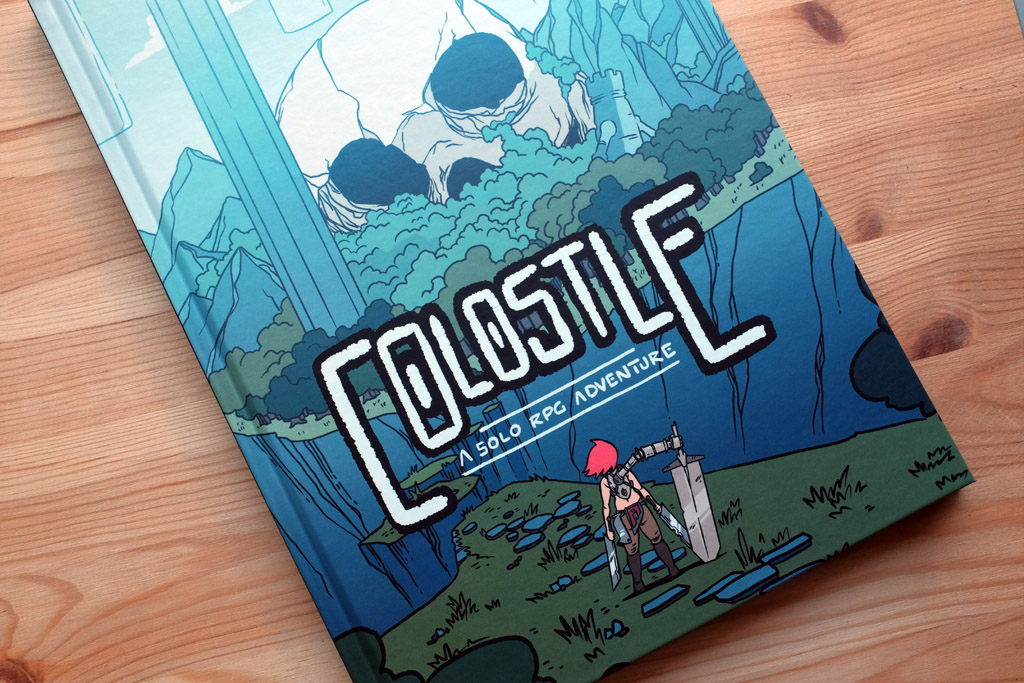
Nich Angell’s Colostle begins with an architectural impossibility and treats it not as allegory but as environment. The game’s world exists entirely inside a single structure: a castle of such scale that seas, cities, plains, and ruins occupy its interior. There is no exterior geography, no sky beyond stone vaults and distant ceilings. The inhabitants of this world do not search for an outside. They live among corridors that stretch for miles and doorways that open onto regions rather than rooms. The name Colostle—a contraction of “colossal castle”—functions less as wordplay than as a statement of physical law.
Published as a solo tabletop role-playing game, Colostle stands apart from the mechanical “crunch” of many contemporary RPGs. The game is played with a standard deck of playing cards and a written journal kept by the player. The journal is not ancillary documentation; it is the primary site of play. What matters is not what is rolled, but what is written.
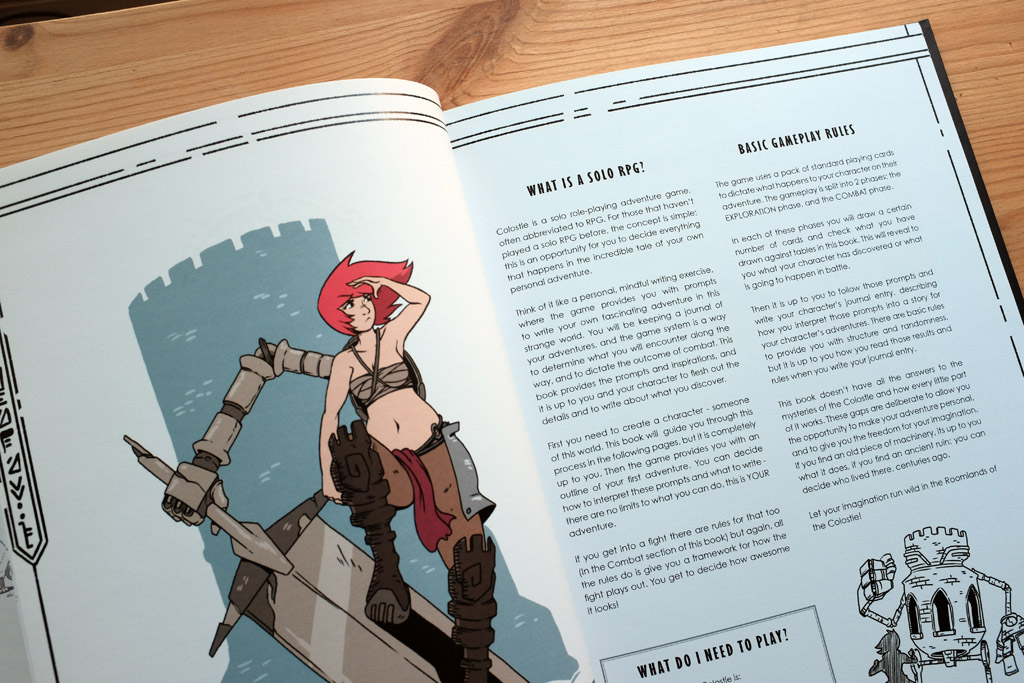
Movement and discovery are governed by card draws from the deck. Each suit corresponds to a category of circumstance—landscape, treasure, combat, or social encounter—and each card value points to a prompt rather than a binary outcome. A drawn card might suggest a breathtaking environmental shift or a moment of quiet passage. Resolution is interpretive. The player reads the prompt, responds in prose, and continues forward. The system refuses closure. It frames events without exhausting them, leaving meaning to be developed through continuity rather than calculation.
Animated Abstract Structures
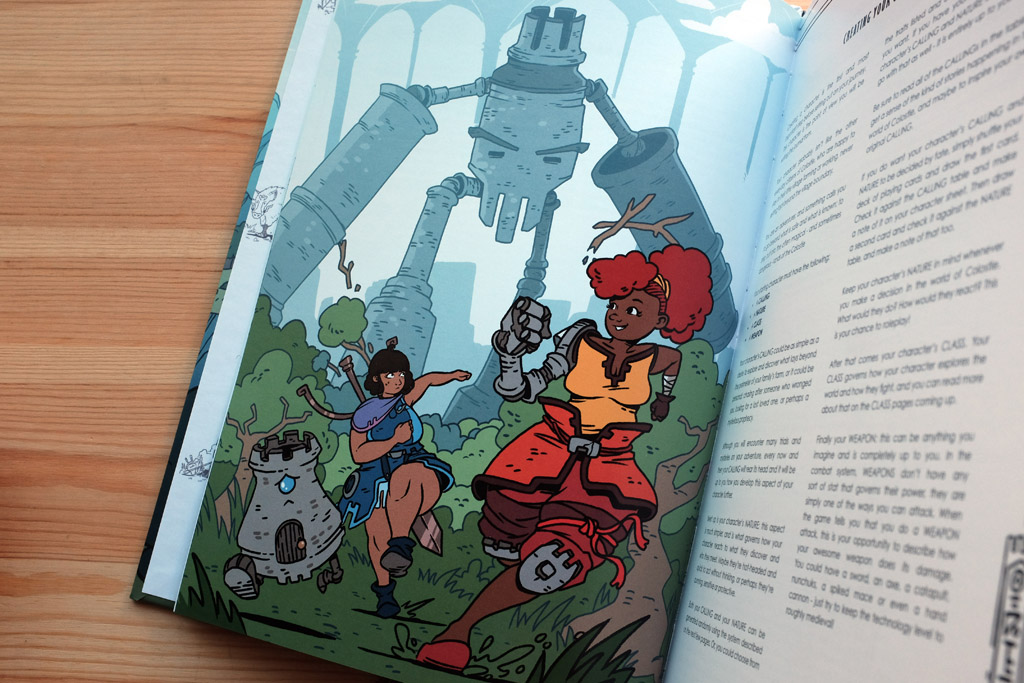
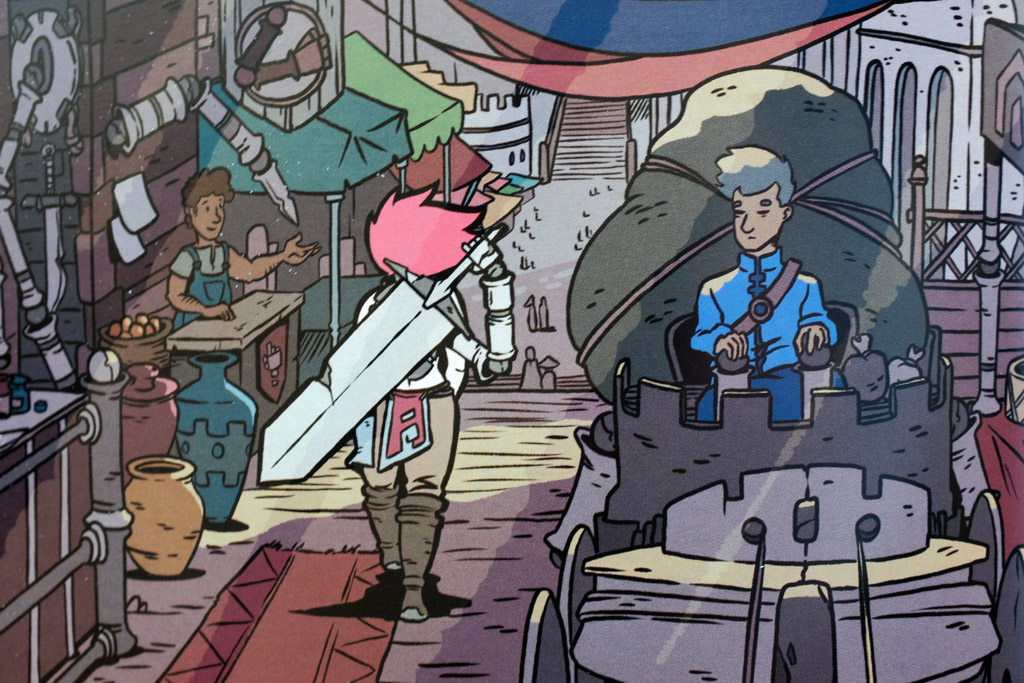
The most prominent figures within the Colostle are the Rooks: vast, animate structures that wander the Roomlands. They resemble walking fortresses or fragments of architecture set in motion. Rooks function as both adversaries and landmarks, their presence shaping the world around them. Confrontations with them are abstracted, resolved through prompts and narrative choice rather than spatial tactics. What matters is consequence—what is gained, what is lost, what changes afterward—not the granular mechanics of the struggle itself.
A Visual Treat to Explore
Visually, Colostle reinforces this sense of scale and restraint. The artwork favors stark compositions and muted tones. Figures are often small, their vulnerability emphasized against immense architectural backdrops. Rooks appear not as fantastical monsters but as inevitabilities—structures that happen to move. The images do not instruct so much as delimit, establishing a narrow tonal corridor within which imagination can operate.
The physical design of the book reflects the same philosophy. Layout is spare and legible. Tables are concise, prompts economical. The book presents itself as a working object rather than a display piece, meant to be returned to repeatedly and marked by use. Although conceived primarily for solo play, an optional cooperative mode allows two players to share the burden of discovery, though the core remains firmly rooted in the act of journaling.
What distinguishes Colostle is not novelty of mechanics but clarity of intention. It does not attempt to simulate a world so much as create conditions for attention. The castle does not demand conquest or explanation. It offers space, prompts, and silence. The rest is left to the person at the table, turning cards and writing what they find.
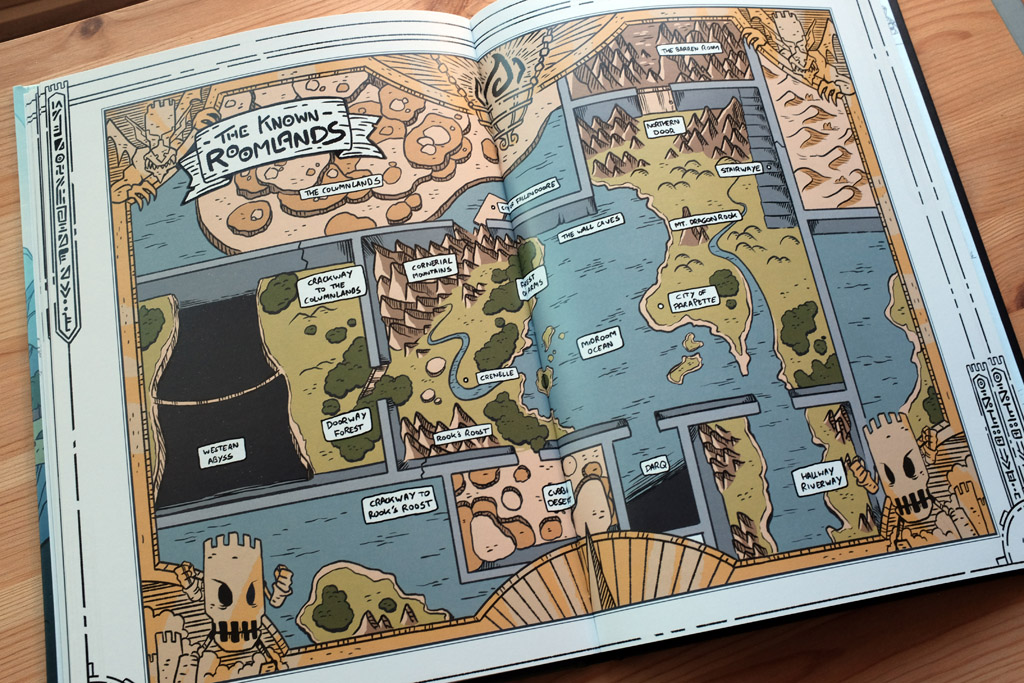
Colostle, created by Nich Angell, is a solo tabletop role-playing game set within an impossibly vast, infinite castle containing entire biomes, oceans, and civilizations. Shifting away from traditional RPG tropes like dice and complex stats, the game utilizes a standard deck of playing cards and a journaling mechanic to drive exploration and discovery. Players take on the role of a “Wayward,” navigating “Roomlands” and encountering “Rooks”—towering, sentient stone automatons. With its minimalist design, evocative monochrome art, and focus on narrative atmosphere over tactical simulation, Colostle offers a meditative and imaginative experience where the primary goal is not to conquer the world, but to witness and record its endless wonders.
Where to Buy Colostle
To support the creator directly and ensure you are getting the official versions of the book and its various expansions, you should visit the official Colostle website at Colostle.com.
Available Colostle Products:
The Base Rulebook: Everything you need to start your journey as a Wayward.
The Roomlands: A major expansion that provides a more guided narrative and deeper world-building.
Job Packs: Card-based expansions that add specific roles and unique prompts to your gameplay.
The Kyodai: A specialized expansion exploring the mechanical giants of the castle.