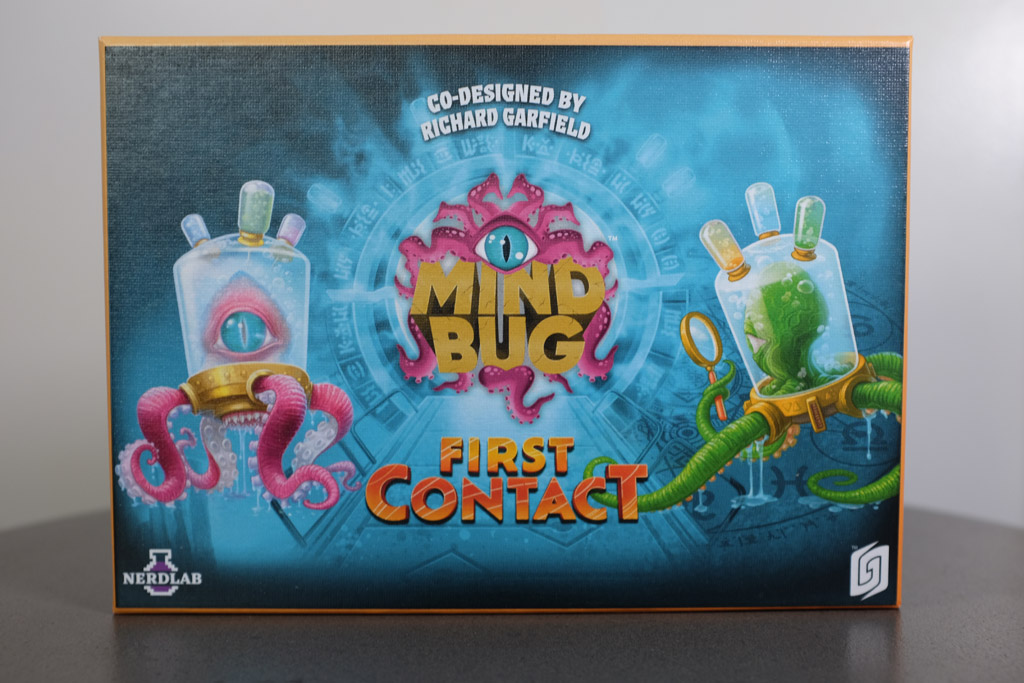
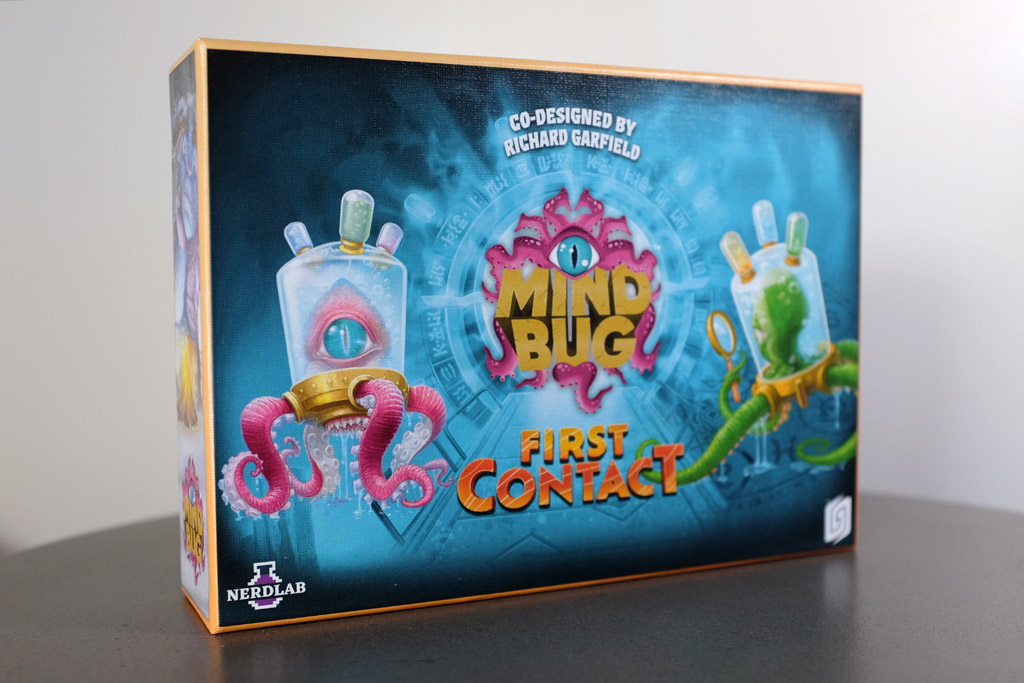
Mindbug: First Contact hit our radar due to a family love for two player combat games. Introduced as a shorter/faster version of TCG battles, Mindbug is a two-player card game designed by Richard Garfield, Skaff Elias, Marvin Hegen, and Christian Kudahl and released in 2022. The design removes traditional deck construction and resource systems while retaining the core of combat, abilities, and life totals. The result is a competitive card game built around immediacy.
The game’s theme is light and fun. The creatures represent bizarre alien or animal hybrids with humorous artwork. The Mindbug character / card is a psychic parasite that can seize control of your opponent’s creature/card at the moment it is deployed. In mechanical terms, this defines the game. In narrative terms, it frames control as unstable and temporary. No creature is fully loyal and no advantage is secure.
Setup and Components
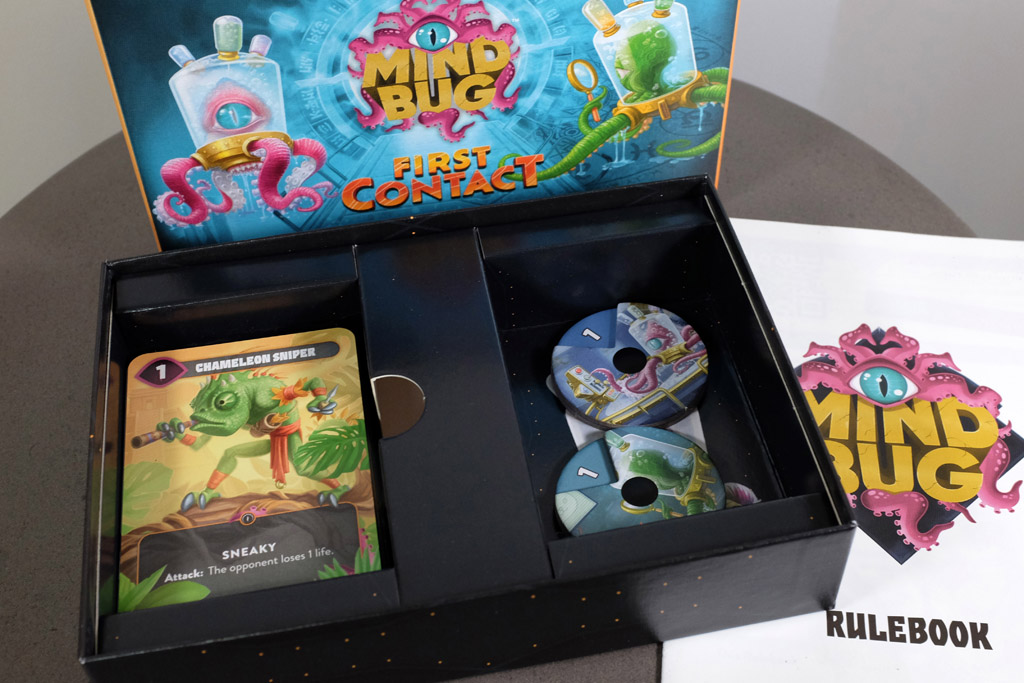
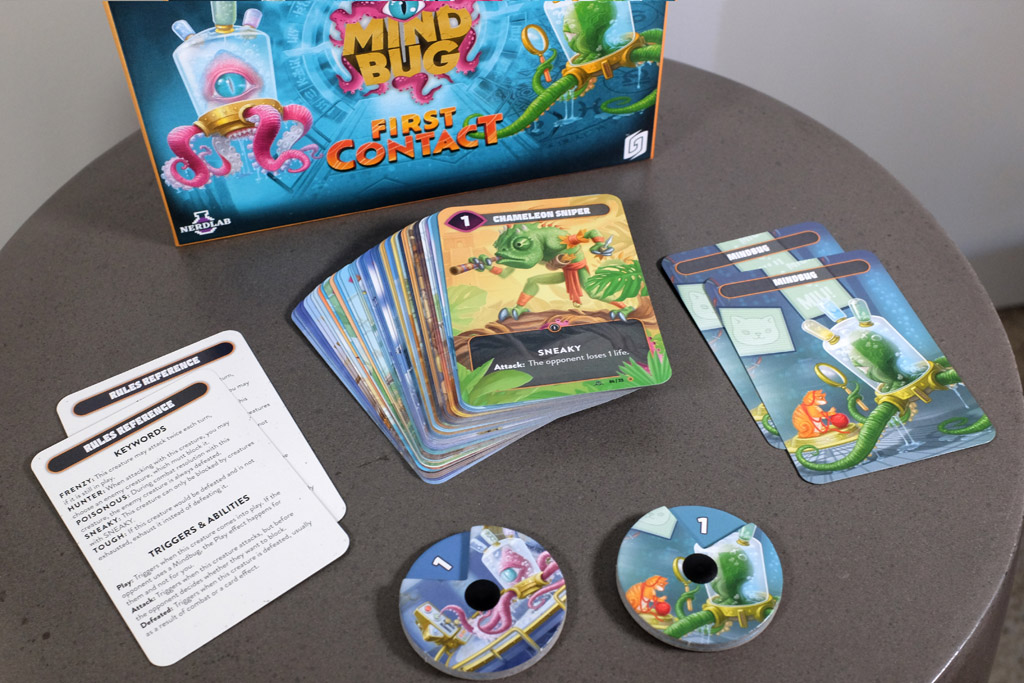
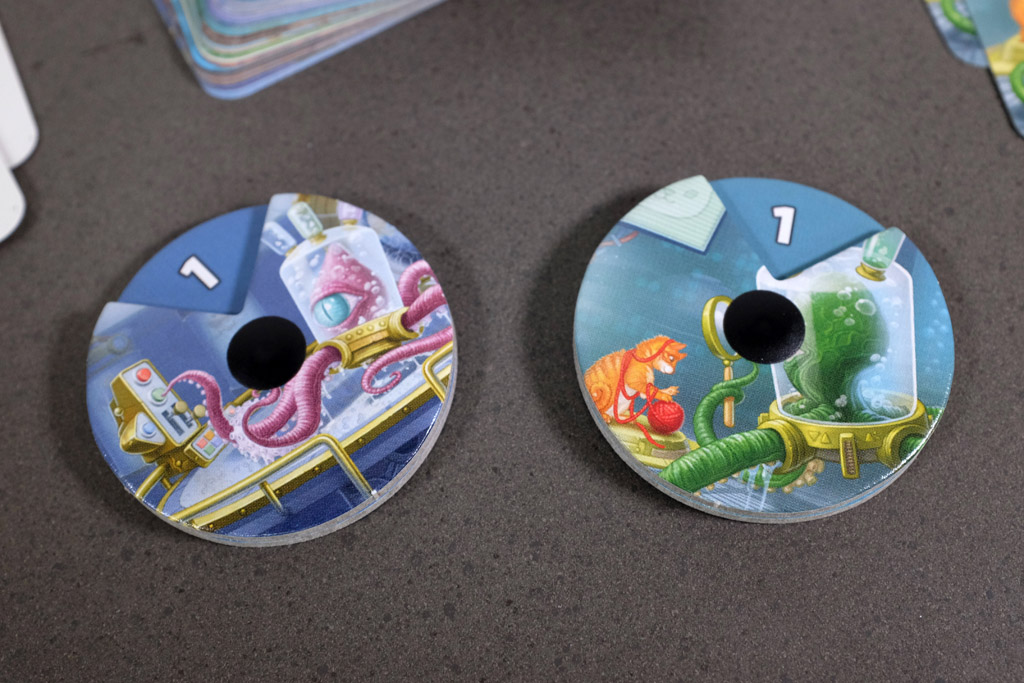
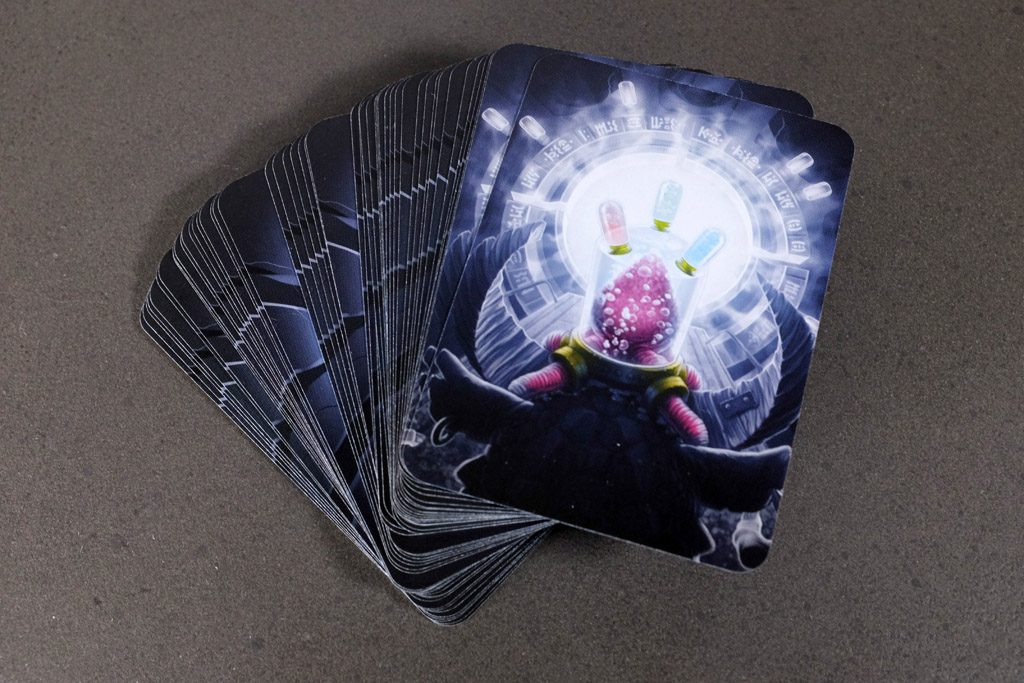
Each battle of Mindbug uses a single shuffled deck of creature cards. Each player receives ten cards from the deck: five in hand and five placed face down as a personal draw pile. Players also receive two Mindbug cards and use trackers to monitor their three life points. Setup is brief and identical every time.
Turning the Tide
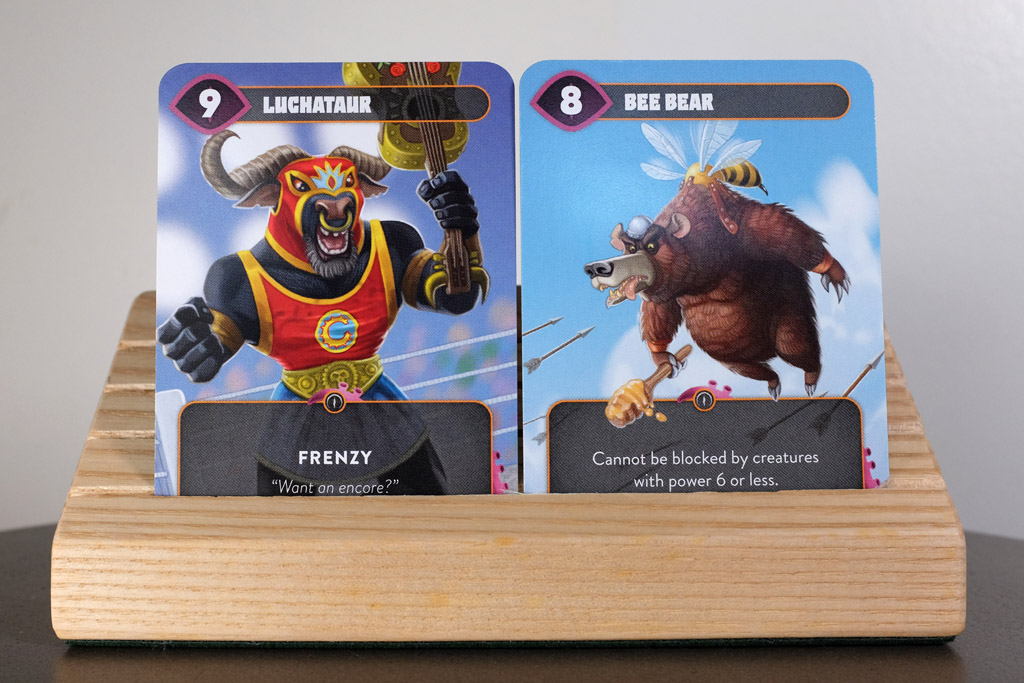
During each turn a player can play a creature from their hand or attack with a creature already in play. Creatures have a power value and specific keywords or abilities. Unlike other card games, there is no “mana cost” to play a creature; if it is in your hand, it can be played immediately.
The central mechanic governs control rather than destruction. When you play a creature, your opponent may discard one of their two Mindbug cards to take control of that creature as it enters play. The creature never resolves on its original owner’s side; instead, the opponent triggers any “Play” effects and may use it on their following turns. Crucially, if your creature is stolen by a Mindbug, you immediately take an extra turn, allowing you to respond to the threat you just inadvertently handed to your opponent.
Once both Mindbugs are spent, control can no longer be stolen this way. The primary tension exists early, when players must decide whether to lead with their strongest cards or “bait out” the opponent’s Mindbugs with lesser threats.
Combat and Interaction
Combat is direct and high-stakes. When a creature attacks, it targets the opposing player. The defender may block with one creature.
- If no block occurs: The defender loses one life.
- If a block occurs: The creature with lower power is defeated / discarded. If creature powers match, both are discarded.
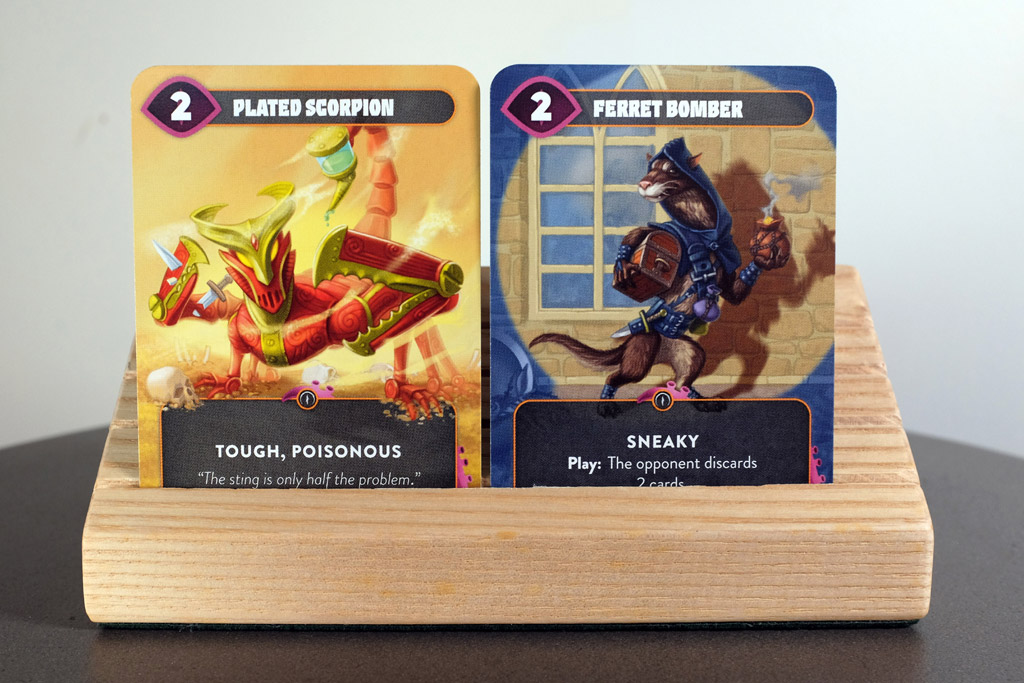
Creature abilities such as Frenzy (attacking twice), Sneaky (can only be blocked by other Sneaky creatures), and Tough (requiring two hits to defeat) alter these outcomes. Each player begins with only three life so games are often decided quickly. Tactical errors are punished immediately.
A New Philosophy of Play
The lack of a resource system reshapes decision-making. In Magic: The Gathering, play is structured around mana availability and long-term scaling. Mindbug removes these constraints. There is no “ramp” and no deck tuning. This shortens games and increases psychological pressure.
While the comparison to Magic is inevitable due to Garfield’s involvement, Mindbug lacks the complexity of phases, instants, or “the stack.” Instead, it is a sequence of exposed decisions under partial information. Since the original First Contact release, the system has expanded into standalone sets like Beyond Evolution (introducing evolving creatures), Beyond Eternity (utilizing the discard pile), and the Battlefruit series (introducing “Harvest” mechanics). All sets can be played independently or combined.
Mindbug: First Contact offers a concentrated form of competitive card play. It replaces infrastructure with threat, asking a simple but agonizing question every time you play a card: “Is this creature too good to give to my opponent?”
How to Play Mindbug: First Contact
Mindbug is a fast-paced card duel where you summon hybrid creatures to defeat your opponent. But there’s a twist: your opponent can mind-control your creatures the moment you play them. Here is everything you need to know to get started.
The Objective of Mindbug
The goal is simple: Reduce your opponent’s life to 0. You start with 3 Life Points. If you lose them all, you lose the game.
Mindbug Game Setup
-
Mindbugs: Give each player 2 Mindbug cards. Place them face-up in front of you.
-
Life Points: Take 3 unused cards (or tokens) per player and place them face-down to track your 3 Life Points.
-
The Deck: Shuffle the creature deck. Deal 10 cards to each player.
-
Draw 5 into your hand.
-
Place the remaining 5 face-down as your personal draw pile.
-
-
Start: Determine a first player randomly.
Mindbug Rules
On your turn, you must do ONE of the following two actions:
Option A: Play a Card
-
Choose a creature from your hand and place it face-up on the table.
-
The Mindbug Moment: Before the creature enters play, your opponent has a choice:
-
Pass: The creature enters your play area. You resolve any “Play” effects and your turn ends.
-
Mindbug It: Mindbug It: Your opponent spends one of their Mindbug cards. They steal your creature! It enters their play area, and they resolve the “Play” effects.
-
The Reset: Because your opponent essentially “interrupted” your turn to take their own action, you immediately take another action. You may play another card or attack with a creature already on the board.
-
Important: If you have fewer than 5 cards in hand after playing, immediately draw back up to 5 from your personal deck.
-
Option B: Attack with a Creature
-
Choose one of your creatures in play to attack. There is no resource management (like mana) in this game. You can play any card in your hand immediately.
-
Opponent Defends: Your opponent chooses one of their creatures to block.
-
If they do NOT block: They lose 1 Life Point.
-
If they DO block: Compare the Power values (the big number on the card).
-
Higher Power wins: The creature with the lower power is defeated (sent to the discard pile).
-
Tie: Both creatures are defeated.
-
-
Key Concepts & Keywords
Creatures often have special abilities. Here are the 5 keywords you need to know:
-
Poisonous: This creature always defeats the enemy creature in combat, regardless of Power. (If the enemy has higher Power, both die).
-
Hunter: When attacking, you choose which enemy creature blocks you. The opponent cannot refuse to block.
-
Tough: This creature has two lives. The first time it would be defeated (by power or Poisonous), it stays in play but becomes “damaged.” You can track this by placing a token on it or using the reminder side of the card. It is only destroyed if it is defeated a second time.
-
Sneaky: This creature can only be blocked by other Sneaky creatures. If the defender has no Sneaky creatures, the attack hits their Life Points directly.
-
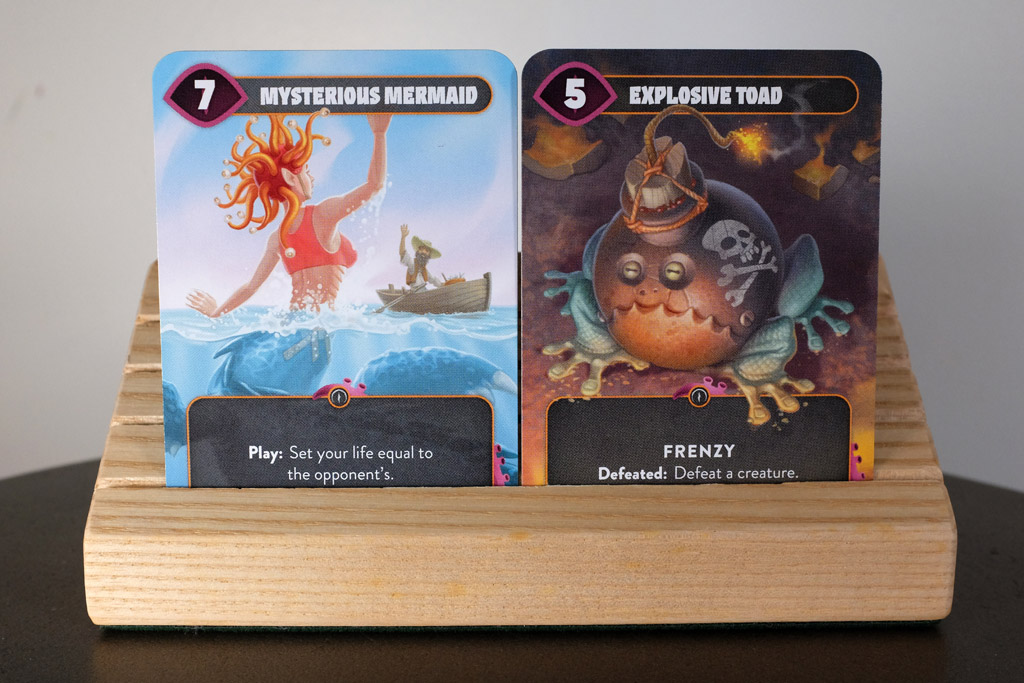
Frenzy: This creature is a relentless attacker. If it attacks and survives the combat, it must immediately attack a second time. The opponent may choose to block this second attack with a different creature or the same one (if it survived).
Card Triggers
Read the text on the cards carefully to see when an ability activates:
-
“Play”: Activates the moment the card enters the table (after the Mindbug phase).
-
“Attack”: Activates when you declare an attack (before the opponent blocks).
-
“Defeated”: Activates when the creature is sent to the discard pile.
Top 5 Beginner Strategies for Mindbug
1. Play Mindbug Chicken: Never play your absolute strongest creature on turn one. Your opponent will almost certainly use a Mindbug to steal it, and suddenly you are facing down your own best card. Lead with a strong, threatening creature that you are okay with losing to tempt them into using up their Mindbugs early.
2. The Threat is Stronger Than the Action: Holding onto a Mindbug is psychological warfare. As long as you have a Mindbug face-up, your opponent will be terrified to play their best cards. Sometimes, not using the Mindbug is better than using it on a mediocre creature just because you can.
3. Treat Every Card as Precious: You only have 10 cards total for the entire game (5 in your hand and 5 in your personal draw pile). Once your draw pile is empty, you will not receive any more cards. This means every “Play” action you take is a finite resource. If playing a card won’t significantly change the board state or force a Mindbug, consider attacking with what you already have to preserve your hand strength for the endgame.
4. Master Keyword Matchups: Don’t waste your powerful creatures on bad matchups.
-
Use Poisonous creatures to take down high-power giants.
-
Save Hunters to snipe annoying utility creatures your opponent is trying to protect.
-
Use Sneaky creatures when your opponent has a board full of big blockers they can’t use.
5. Know When to Go Face: Ultimately, you win by dealing 3 damage to the opponent, not by killing all their creatures. If your opponent has no good blockers, or you have a creature they are afraid to block (like a Poisonous one), take the shot at their Life Points!