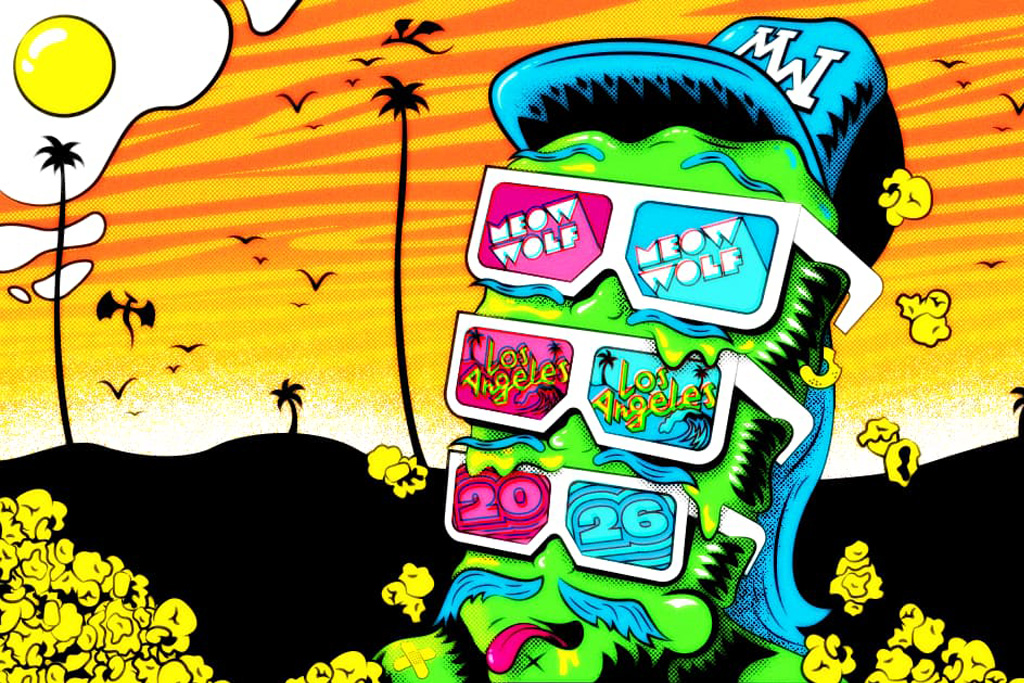
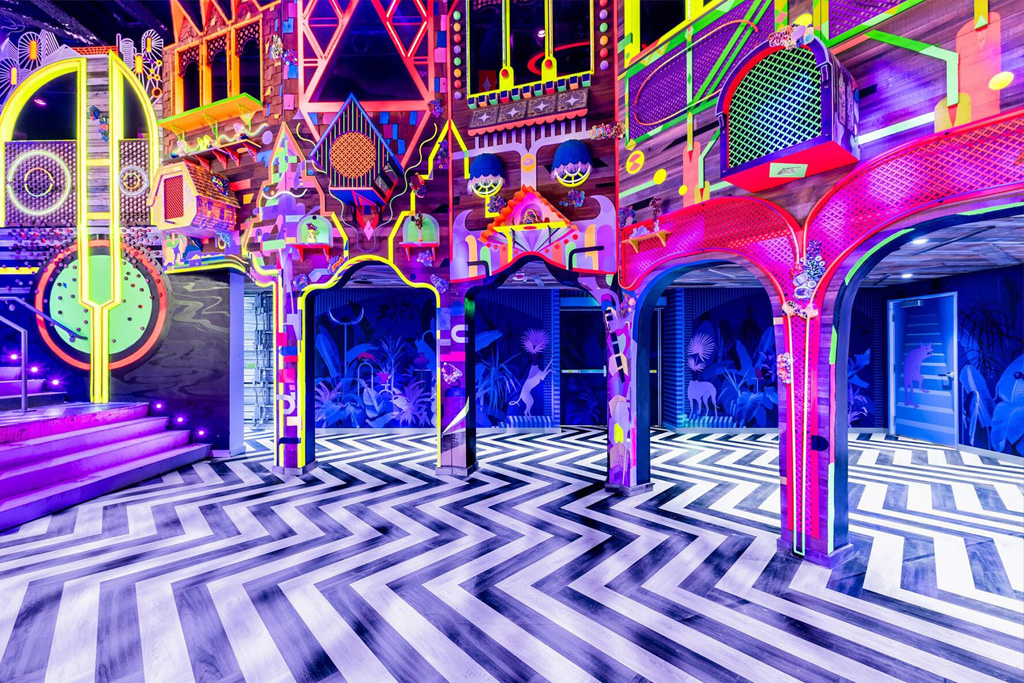
Meow Wolf’s long-anticipated Los Angeles exhibition will open in late 2026 inside a former Cinemark multiplex at the Howard Hughes Center in West L.A., near Los Angeles International Airport, marking the immersive art company’s sixth permanent location. The project, previewed by The Los Angeles Times in early January, reframes the movie theater itself as both subject and stage: a decaying 1990s-era cinema that dissolves into a labyrinth of interactive rooms, animated objects, and speculative narratives about change, memory, and the stories people consume together in the dark.
From Santa Fe to Los Angeles, by Shipping Container
The Times was granted access to Meow Wolf’s Santa Fe headquarters, where large sections of the Los Angeles exhibition are being assembled and packed for shipment west. In a video report and accompanying article published Jan. 7, reporter Todd Martens described a space already thick with symbolism. Shipping containers lined the compound, filled with art bound for California. Installation in Los Angeles is expected to begin in the coming weeks.
Enter Through the Multiplex
Unlike Meow Wolf’s other locations—entered through a surreal grocery store in Las Vegas or a haunted domestic interior in Santa Fe—the Los Angeles experience begins in a multiplex. Co-founder and executive vice president Sean Di Ianni told the Times the team is deliberately evoking the texture of a bygone era. “Sticky floor, popcorn vibes,” he said, describing a space designed to feel like a 1990s cinema, down to the waiting areas and concession counters. Familiarity is the lure. Disorientation comes later.
Sentient Candy and Analog Video Ghosts
That disorientation arrives quickly. One of the first installations guests encounter is a concession stand where candy has become sentient. Forgotten gummies and abandoned pizza slices appear suspended in aquarium-like cases, glowing and animated, as if neglect itself has produced consciousness.
Nearby sits a functioning café that doubles as an installation. Neon sculptures—a bunny, a martini glass—loom overhead, while a projection wall behind the bar plays original video engineered to look decades old. Video designer Sue Slagle told the Times that the work draws from early experimental video art made possible by custom-built circuits in the 1960s and ’70s. The images feel analog because they are meant to recall invention, not nostalgia.
Breaking Into the Story
Throughout the exhibition, Meow Wolf is expanding its use of mixed media. According to Martens, the Los Angeles show incorporates live action and animation, shadow boxes, interactive games, and even a miniature escape room—though here, visitors must break into a hidden space rather than escape from it.
Elizabeth Jarrett, the exhibition’s creative director, framed the project as a study in narrative itself. “This exhibition is about the inevitability of change,” she told the Times, “and how the stories that we tell ourselves and others have the ability to affect the way we perceive change and the way we experience it.”
Space Bikes and Kaleidoscopic Motion
Science fiction remains a structural language. One gallery features two rideable space bikes positioned before a giant screen that simulates motion through abstract environments. One bike is ADA-compliant. Artist Chris Hilson explained that the bikes’ unusually complex tires conceal monitors displaying shifting spatial imagery. The engines spin like kaleidoscopes. The effect is not speed, exactly, but immersion.
Inside the Dream Freighter
At the center of the exhibition sits its most elaborate object: the Dream Freighter. Hilson described it to the Times as “a living time-, space-traversing vessel,” vaguely fish-shaped, neither fully mechanical nor convincingly biological. Inside, a large interactive control panel allows guests to twist knobs and flip switches, jumping between intergalactic worlds—or perhaps dreams misremembered as places. Hilson has described the aesthetic as “bio nouveau,” an attempt to fuse organic form with industrial logic.
A Place to Stop and Breathe
For all its maximalism, the Los Angeles exhibition also includes a deliberate pause. One anchor space is designed for quiet. Shakti Howeth, a creative director on the project, told the Times it will function as a decompression room, built with sustainable materials and capped by a mycelia ceiling.
Mushrooms recur throughout the exhibition. A 30-foot-tall mushroom tower, explorable and riddled with hidden interactions, offers secluded pockets for reflection. Howeth said it was important for the Los Angeles show to honor the organic alongside the electronic.
Artists, Dreams, and a City Reflected Back
Dozens of artists are contributing. Gabriela Ruiz’s hyper-colored, insect-like periscope structure was under construction during the Times’ visit. The collective Everything Is Terrible is also involved, bringing its fractured archive of corrupted media and cultural debris. One artist described the work to Martens as reflecting “the madness and broken and unrealized dreams of Los Angeles”—a line that lands less as critique than recognition.
Meow Wolf has described the exhibition as a meditation on storytelling, but its setting suggests something more specific. Los Angeles is a city built on images, rituals of spectatorship, and the shared suspension of disbelief. By hollowing out a multiplex and filling it with living artifacts, Meow Wolf is not simply paying homage to cinema. It is examining what happens when the stories stop behaving, and start answering back.