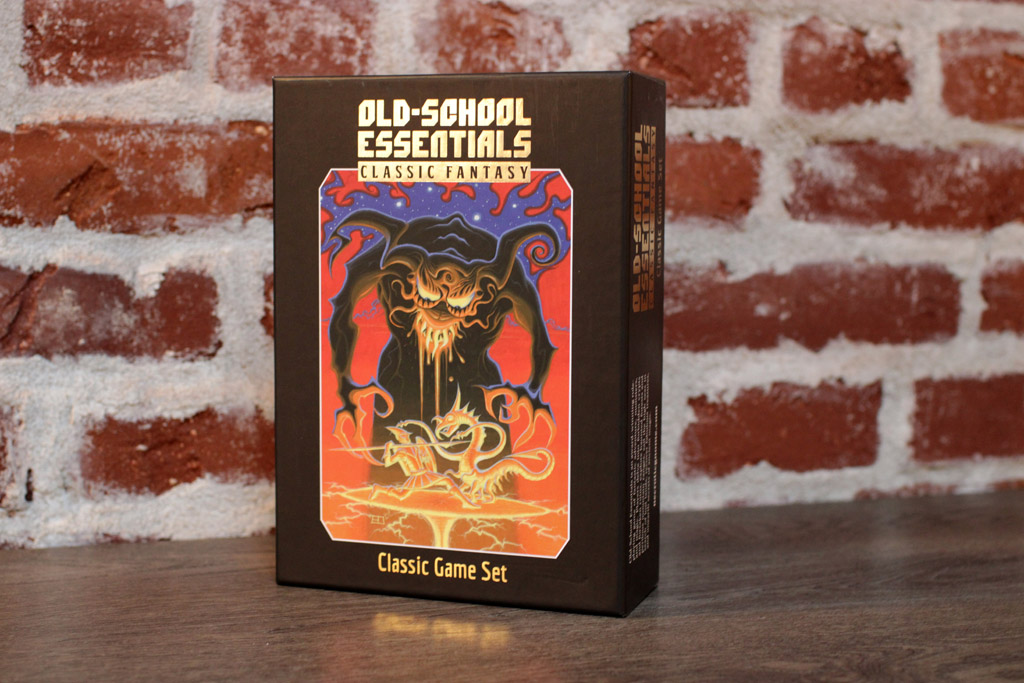
Old-School Essentials sits near the center of today’s Old School Renaissance: a modern rules presentation that closely resembles the 1981 Dungeons & Dragons Basic and Expert boxed sets (often shortened to B/X.) The series comes from Gavin Norman and his publisher Necrotic Gnome, updating those classic rules for modern tabletops.
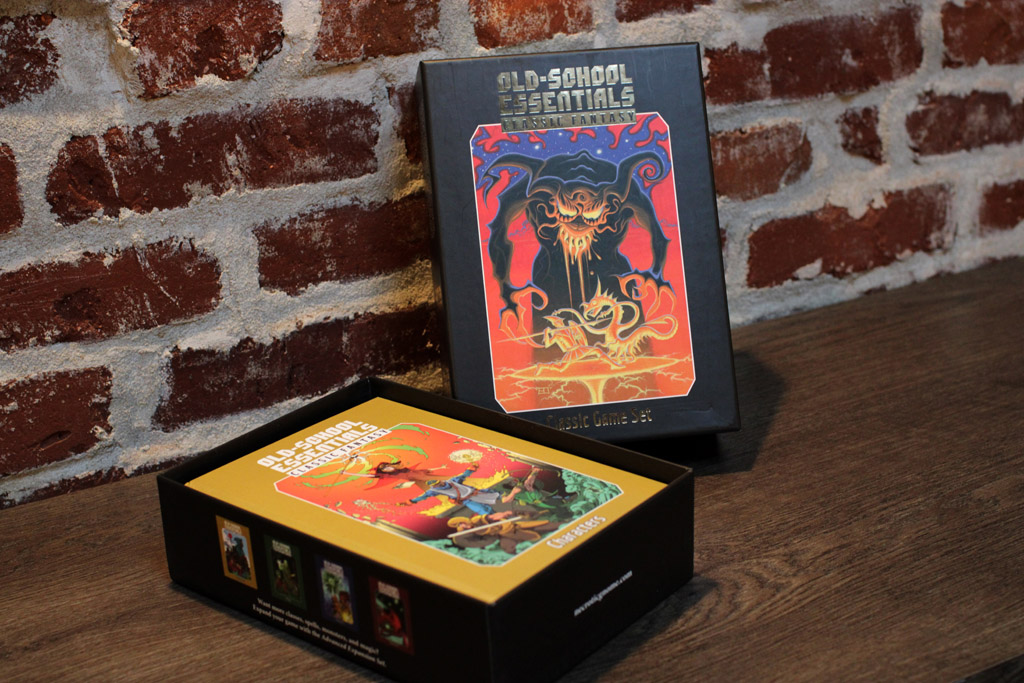
The Old-School Essentials Classic Game Set packages the Classic Fantasy rules as five A5 hardcover books inside a deluxe box, with sewn bindings and quick-reference endpapers meant for constant handling. Exalted Funeral lists the set as published by Necrotic Gnome and Exalted Funeral Press, with a box cover painted by Erol Otus and individual book covers by David Hoskins.
A Rules Clone with Editorial Ambition
The development of Old School Essentials came from Norman’s earlier B/X Essentials work—a series of modular, zine-style booklets released between 2017 and 2018. Norman, a British-born designer based in Berlin, brought a unique professional background to the project: a career in technical writing. This influence is visible in the game’s surgical style which strips away the conversational fluff of 1980s gaming manuals in favor of bullet-point clarity.
In a 2018 interview, Norman described the project’s goal in blunt, table-facing terms: he aimed for usability “designed with one question in mind: how can these books be the best in-play rules references possible?” He sought to eliminate the “wall of text” problem that plagued early RPGs, where a referee might have to hunt through three different chapters to resolve a single combat maneuver.
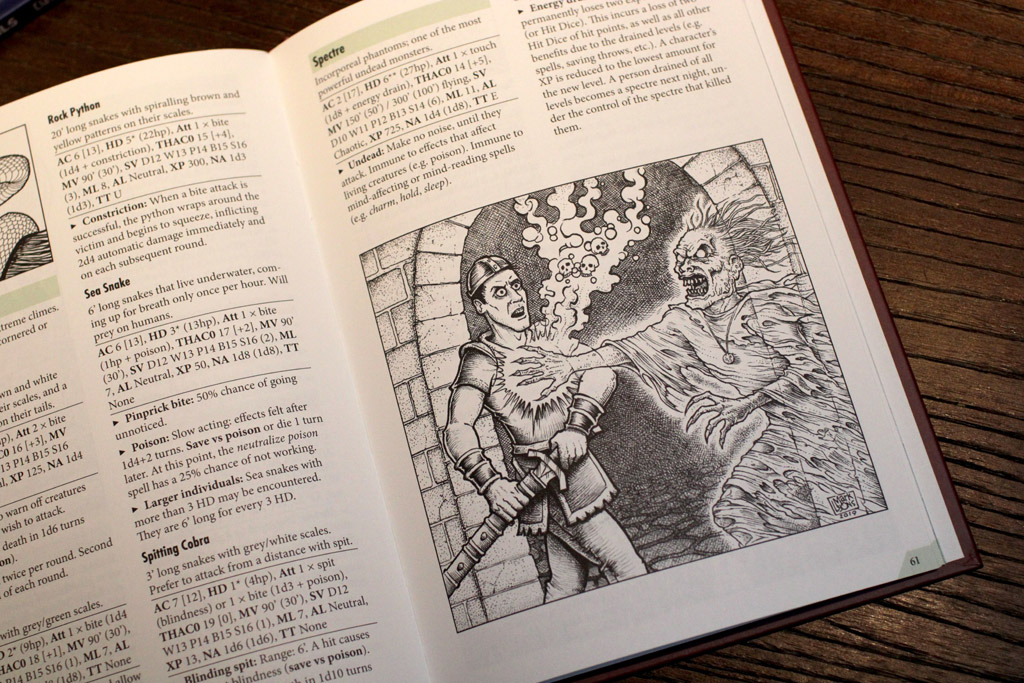
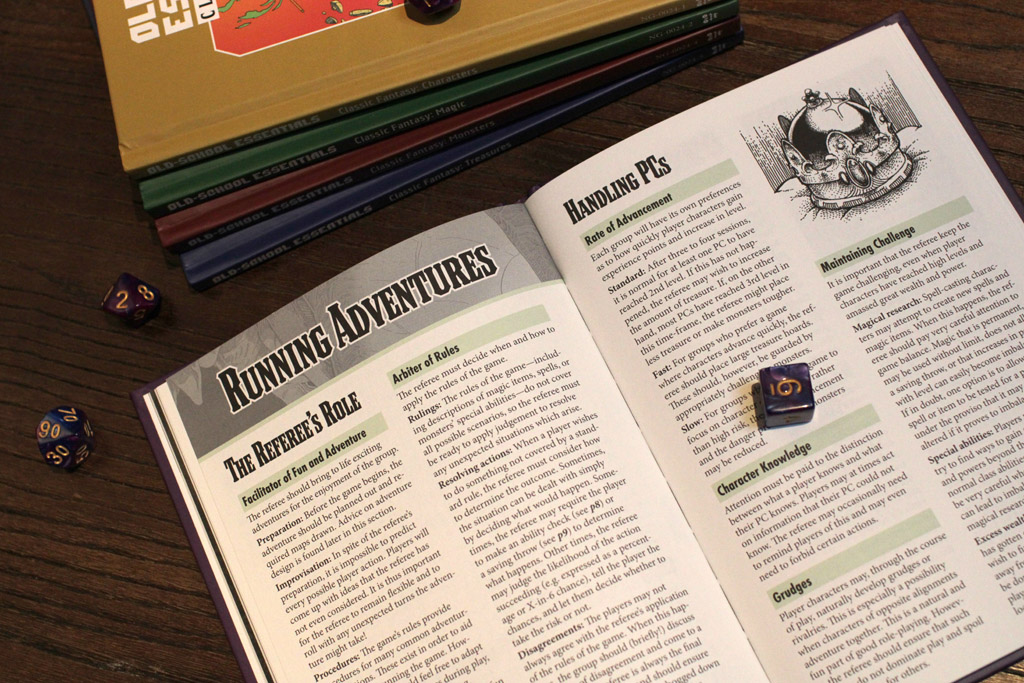
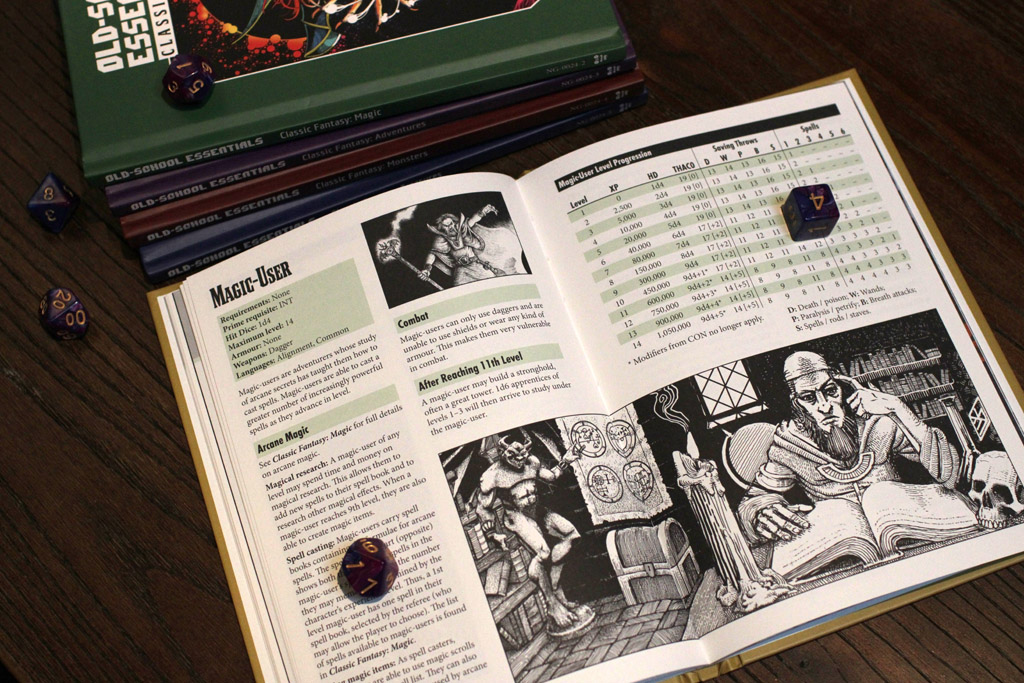
OSE launched publicly via a massive Kickstarter campaign in 2019. Necrotic Gnome frames OSE the same way on its site today: it uses “light, easily modified rules” and organizes each topic into paired control panels. This is Norman’s signature layout achievement—a philosophy where every topic is strictly contained within a two-page spread. This prevents the “page-flip” bottleneck, ensuring that the information a referee needs is always immediately visible in its entirety.
OSR as a Cultural Renaissance
The OSR (aka “Old School Renaissance” or “Old School Revival”) grew as a loose scene of players, bloggers, designers, and small publishers who gravitated toward early D&D-style procedures. This wasn’t merely a “nostalgia club” for older players, but a rejection of the high-complexity, “heroic” design of the 2000s in favor of exploration, resource pressure, and referee rulings. While Wikipedia traces early forum use of “old school revival” (2004) and “old school renaissance” (2005) to sites like Dragonsfoot and Knights & Knaves Alehouse, the movement’s technical backbone was the 2000 Open Game License (OGL). This legal framework allowed creators to use the mechanical “SRD” of D&D to legally reverse-engineer and “clone” out-of-print rulesets.
The philosophical soul of the movement was famously captured in Matt Finch’s Quick Primer for Old School Gaming(2008), which coined the “Rulings, Not Rules” mantra. Finch argued that old-school play rewarded player cleverness over character sheet “powers”—a philosophy that remains the heartbeat of OSE today. A useful snapshot of this era comes from James Maliszewski’s Grognardia blog, which from 2008 to 2012 served as the movement’s “town square,” documenting a network of fanzines and DIY designers who wanted to treat 1970s and 80s rules as a living, breathing hobby.
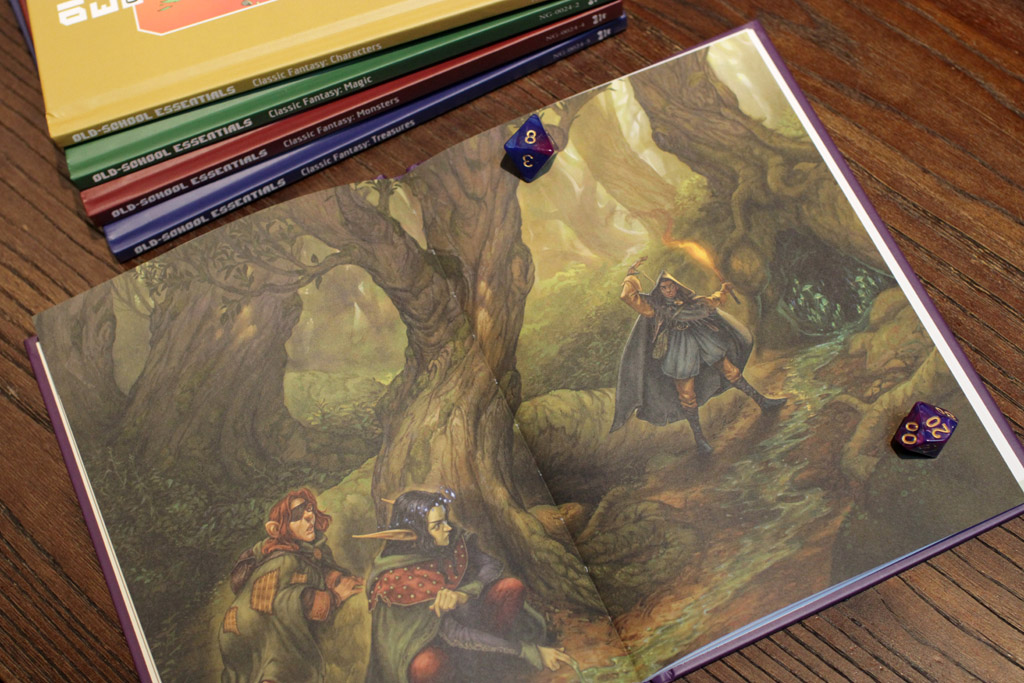
OSE arrived as the “Third Wave” of this renaissance. While early “retro-clones” like OSRIC (2006) or Labyrinth Lord(2007) successfully brought old rules back into print, they often inherited the dense, confusing layouts of the original books. OSE fits the revival impulse while solving a practical OSR problem: many groups love B/X’s procedures but dislike hunting for rules across scattered sections. By treating the 1981 rules with the rigor of modern UI design, OSE sells organization as a feature, making the “Old School” accessible to a generation that didn’t grow up with the original boxed sets.
How Old-School Essentials Plays
Old-School Essentials Classic Fantasy runs on a compact, high-lethality engine that prioritizes player skill over character power. The mechanics are designed to facilitate “emergent gameplay,” where the story is what happens at the table, not what is written in a backstory.
Ability Scores: Characters start with six ability scores—Strength, Intelligence, Wisdom, Dexterity, Constitution, and Charisma. In the strictest “Old School” tradition, these are rolled 3d6 in order, meaning players must often find a creative way to play a character with “sub-optimal” stats.
Classes and “Race-as-Class”: Classic Fantasy includes the four core human classes—Cleric, Fighter, Magic-User, and Thief. Crucially, it retains the B/X “race-as-class” system: if you play a Dwarf, Elf, or Halfling, that is your class. This preserves the archetypal “fairy tale” balance where demihumans have unique abilities (like the Elf’s mix of fighter and magic-user) but face lower level caps than humans.
Procedural Time Management: The referee tracks time in 10-minute “Dungeon Turns.” This isn’t just bookkeeping; it is the game’s primary tension-builder. Every two turns, the referee checks for wandering monsters, and players must constantly monitor their light sources (torches and lanterns) and encumbrance, making every minute spent “searching for traps” a meaningful resource drain.
Combat Resolution: Combat is fast and often deadly. Each round starts with declarations for spells and melee movement, followed by a 1d6 side initiative roll (where one side’s entire team acts at once). The round follows a strict, phased sequence: Morale, Movement, Missile attacks, Spells, and finally Melee. Because spellcasters must declare their intent before initiative, they risk losing their spell if they are hit before their phase.
Saving Throws: Unlike modern “Difficulty Class” systems, OSE uses five classic, static categories: Death/Poison, Wands, Paralysis/Petrification, Breath, and Spells/Rods/Staves. These scores improve as characters level up, representing a character’s growing “luck” and resilience against specific environmental hazards.
XP through Extraction: Advancement rewards exploration, not just killing. OSE explicitly makes recovered treasure the primary XP source: 1 XP per 1 gp value for non-magical treasure brought back to safety. Monster XP is significantly lower by comparison, which encourages players to use stealth, bribery, and cleverness to bypass monsters rather than fighting every creature to the death.
Inside the Five Books of the Classic Game Set
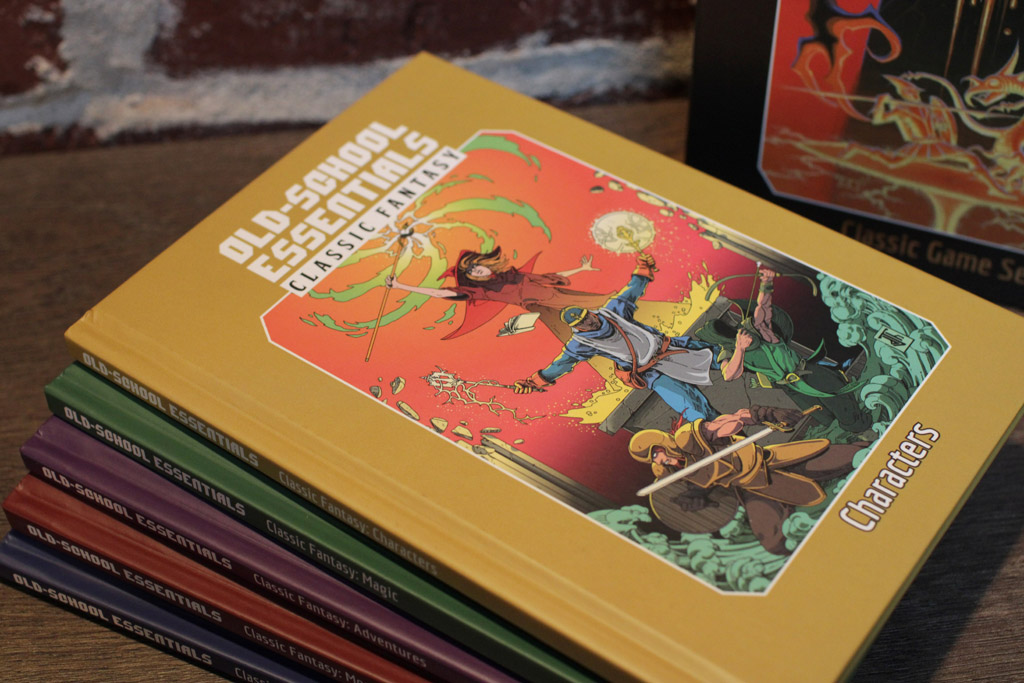
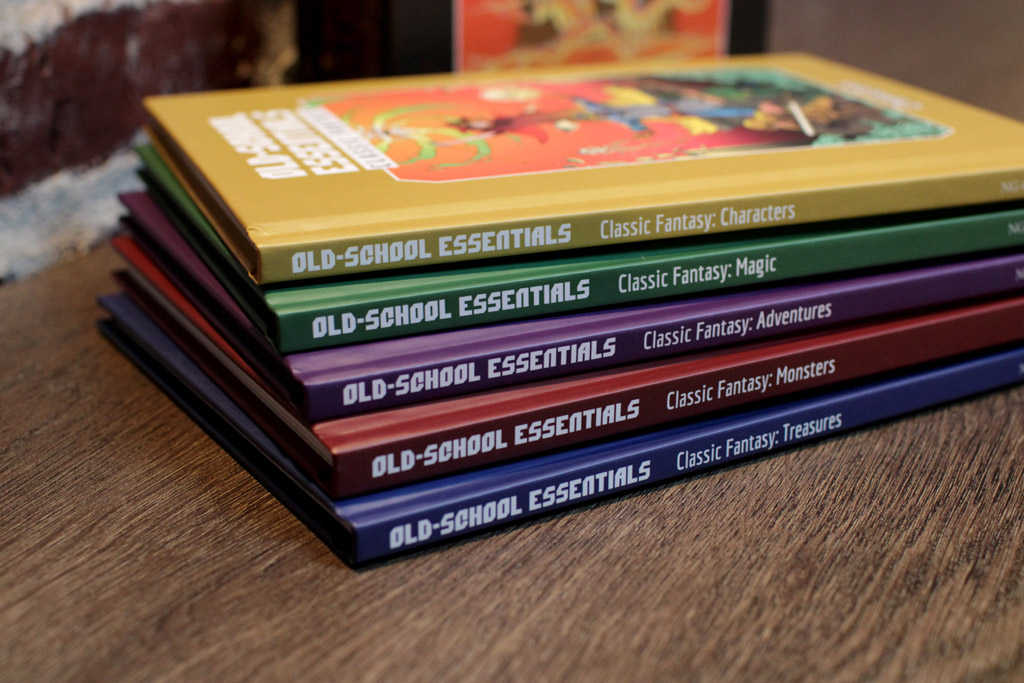
Necrotic Gnome describes the Classic Game Set as the exact functional equivalent of the Classic Fantasy Rules Tome, but modularized for the physical table. While a single book can become a bottleneck during a session, this set is designed for simultaneous use. The manufacturing reflects this high-traffic intent: five A5 hardcovers featuring durable sewn bindings and wrap-around endpapers that serve as a “mini-GM screen” for the specific rules contained within each volume.
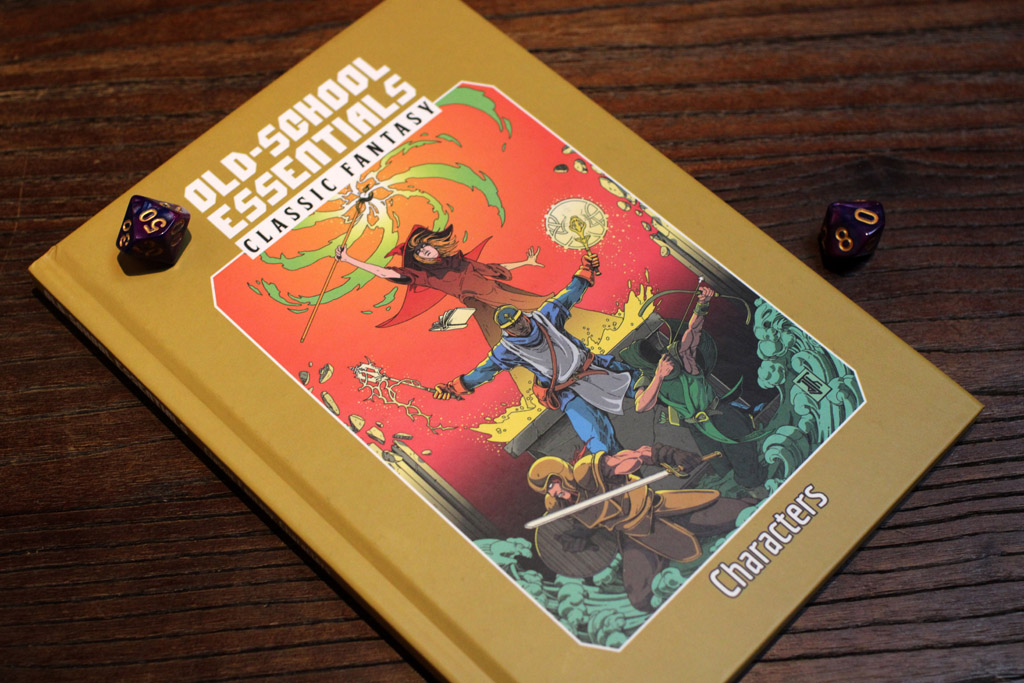
Book 1: Characters – This volume acts as the player’s handbook. It covers levels 1 through 14 for the seven core classes (Cleric, Dwarf, Elf, Fighter, Halfling, Magic-User, and Thief). Beyond stats, it includes the essential “logistics” of old-school play: equipment lists, hireling contracts, and the rules for wilderness travel and establishing strongholds once players reach “Name Level.”
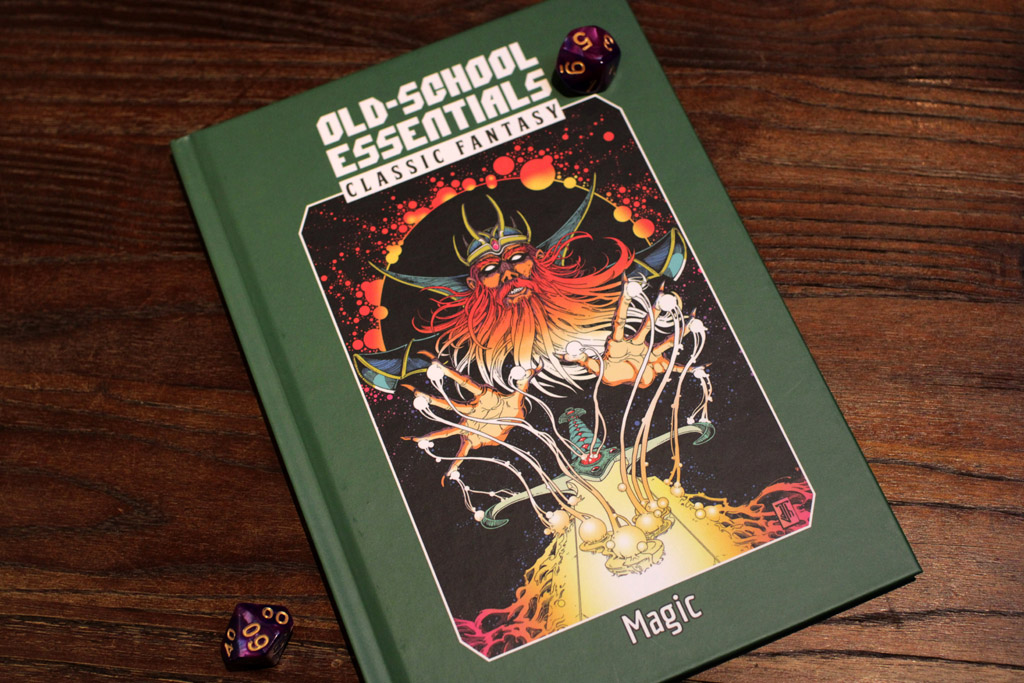
Book 2: Magic – Dedicated entirely to the arcane and divine, this book contains 34 cleric spells (Levels 1–5) and 72 magic-user spells (Levels 1–6). It also outlines the procedures for “Magic Research,” allowing high-level casters to create their own spells and brew potions—a core late-game mechanic in the B/X tradition.
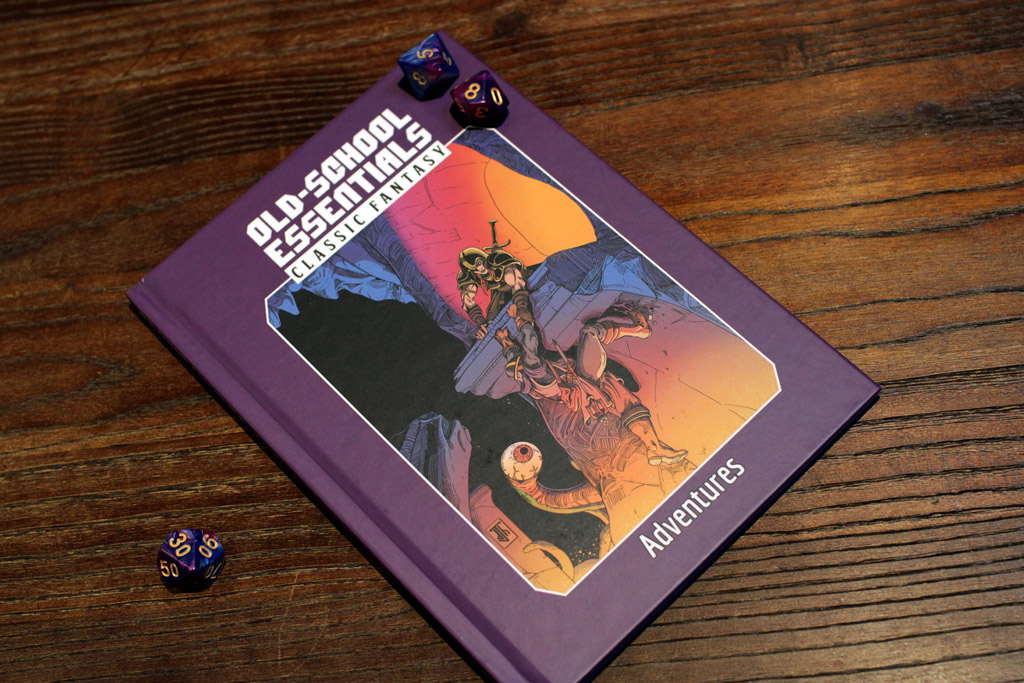
Book 3: Adventures – This is the referee’s primary manual. It concentrates the day-to-day procedures of the game: dungeon exploration, wilderness navigation, and encounter rules. It also provides the “adjudication tools” necessary for a referee to stock dungeons and manage the hazards of the deep—from traps to falling damage.
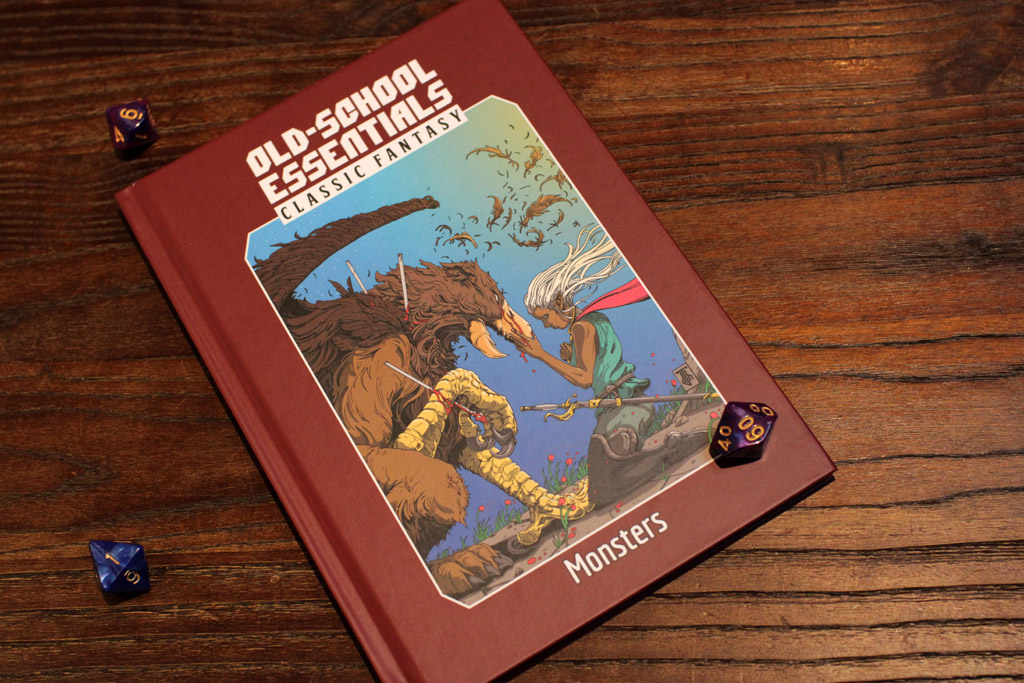
Book 4: Monsters – The creature catalog features over 200 monsters, each presented with the same “control panel” layout philosophy found elsewhere in the system. Every entry is designed to be read at a glance during combat, providing stats, movement rates, and special abilities without requiring a page-turn.
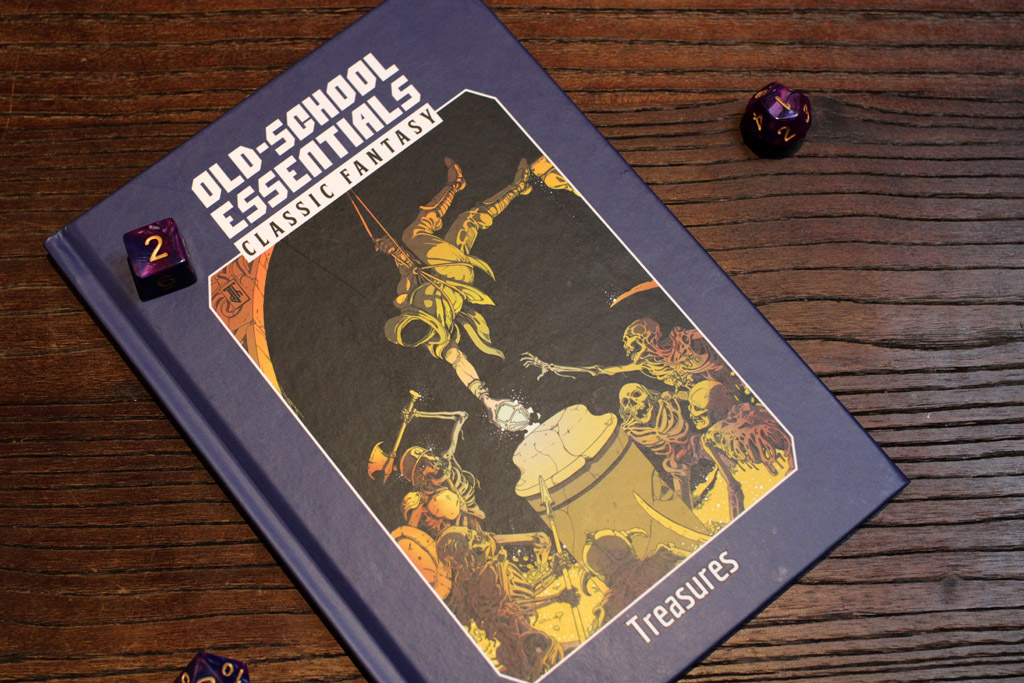
Book 5: Treasures – The final piece of the reward economy, this book details over 150 magic items and the expansive treasure tables required to generate loot. Since OSE ties character progression to treasure extraction, this book is effectively the “Experience Point Manual” for the referee.
By splitting these into five volumes, a gaming group can have the Thief looking up adventuring gear in Characters, the Magic-User checking a spell in Magic, and the Referee consulting Monsters and Adventures all at the same time. The box isn’t just a container; it’s a way to de-clutter the table and keep the game moving.
The Magic of the Black Box: Table Usability
Old-School Essentials’ greatest strength isn’t just its shelf appeal; it is how the game functions in the heat of a live session. The set’s split-book format makes literal its core editorial promise: quick reference, fewer bottlenecks, and more eyes on the rules at once. Gavin Norman has consistently stated that he built the line around table usability, and the Classic Game Set turns that philosophy into a physical workflow. By dividing the rules into five volumes, the table’s “Information Architecture” changes:
The Players keep Characters and Magic for quick class and spell lookups.
The Referee keeps Adventures, Monsters, and Treasures behind the screen.
The Bottleneck—the “queuing” for a single, heavy core rulebook—is effectively eliminated.
The box also serves as a visual bridge to the past. By commissioning Erol Otus—the artist whose psychedelic, high-contrast style defined the 1981 Moldvay Basic cover—Necrotic Gnome signals that this is the spiritual and literal successor to that era. The individual book covers by David Hoskins further reinforce this “New Old School” aesthetic, blending modern professional art with the gritty, lived-in feeling of early fantasy illustrations.
Ultimately, OSE has endured because it provides the OSR community with a stable, highly legible “Rosetta Stone.” It stays 100% compatible with decades of older modules, from 1980s classics like B2: The Keep on the Borderlands to modern masterpieces. Necrotic Gnome makes this compatibility claim explicitly, framing Classic Fantasy as a “complete rendition” of the 1981 rules—proving that good design never truly goes out of style.
Old-School Essentials Classic Game Set is more than just a tribute—it is a toolkit. It proves that the “Old School” wasn’t just about nostalgia. This type of tabletop role playing offers a high-stakes, player-driven adventure that remains just as thrilling today. By prioritizing the physical workflow of the table over the prose-heavy style of traditional manuals, Gavin Norman has created a bridge across forty years of gaming history. In a hobby often bogged down by complex “math-finder” mechanics and endless page-flipping, OSE stands as a testament to the power of clean design. It isn’t just a game; it is the definitive way to play the world’s most famous fantasy RPG.
Find more information on the Old School Essentials Box Set and purchase a copy at Exalted Funeral