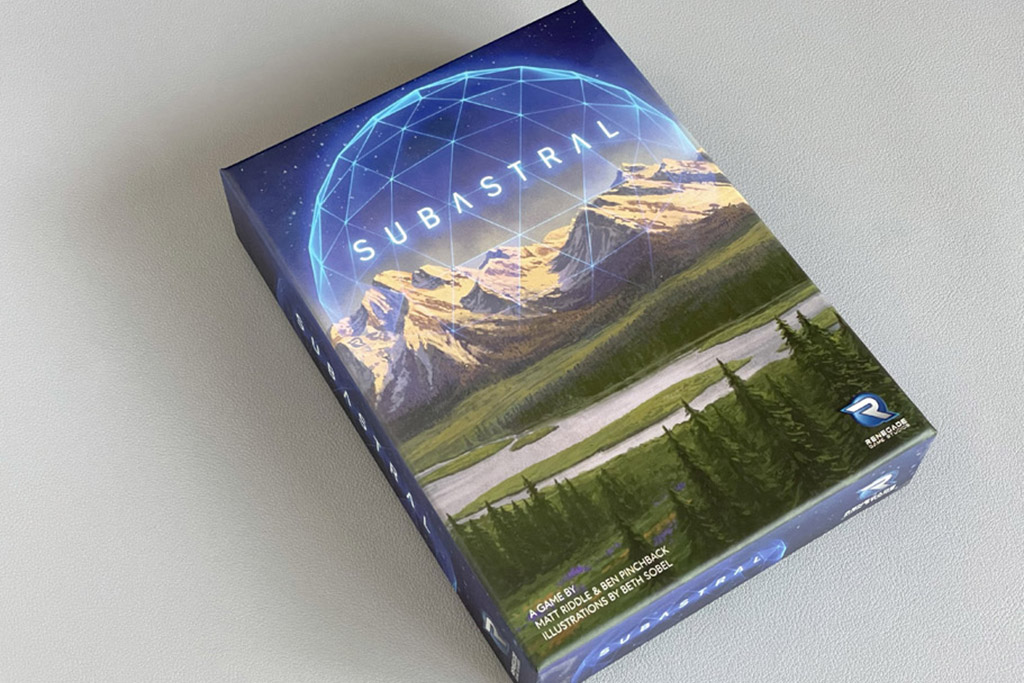
Subastral is a compact strategy card game about building a research journal of Earth’s biomes, published by Renegade Game Studios in 2021. It’s designed by Matt Riddle and Ben Pinchback, with illustrations by Beth Sobel, and it plays in about 15–30 minutes for 2–5 players (ages 10+).
The Core Loop: The Weather Matters
The hook sits in the middle of the table: six “cloud” cards numbered 1–6, bracketed by the biome deck on the left and a sun card on the right. You don’t simply draft a card and file it. Each turn forces you to send a card into the weather, then harvest a different cloud—either restocking your hand or permanently recording notes into your journal—based on where that cloud sits relative to what you just played.
That physical layout carries the theme. Subastral frames players as researchers assembling field notes across eight biomes, from tropical rainforest to arctic tundra, and the scoring asks a pointed question: does your journal show depth (big piles of a biome) and breadth (continuous runs across many different biomes)?
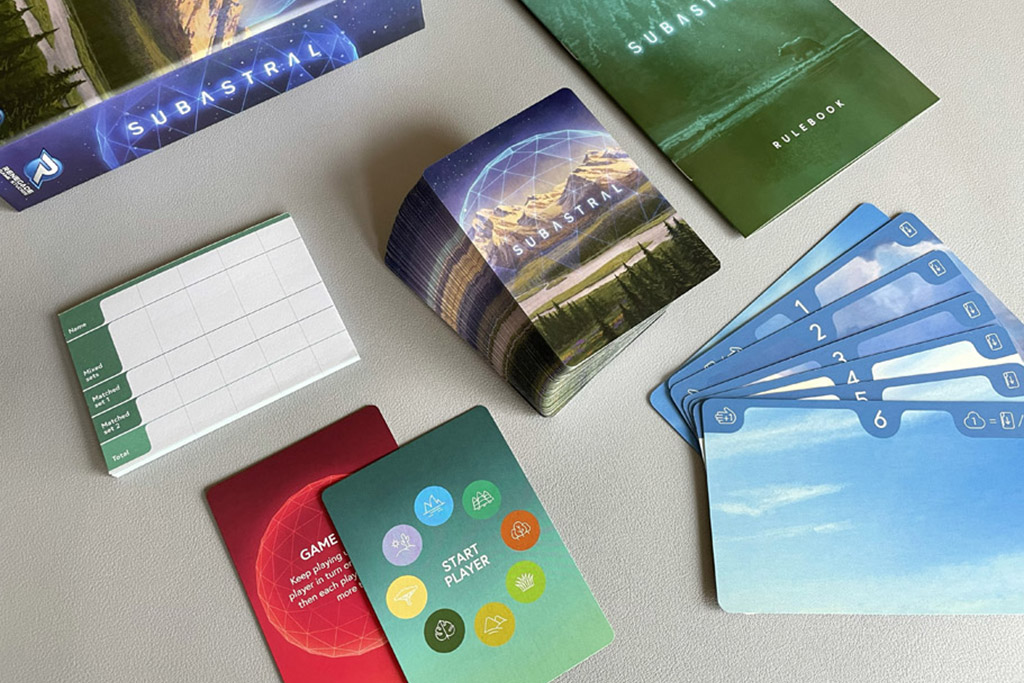
Mechanically, the journal matters because it’s ordered. The first time you add a biome to your journal, you decide where that pile lives left-to-right, and that decision echoes in final scoring: mixed-set scoring reads your journal from pile 1 onward, and matching-set scoring pays more per card for piles placed farther to the right. The game’s tension comes from engineering that order while the cloud row keeps shifting and tempting you with partial information.
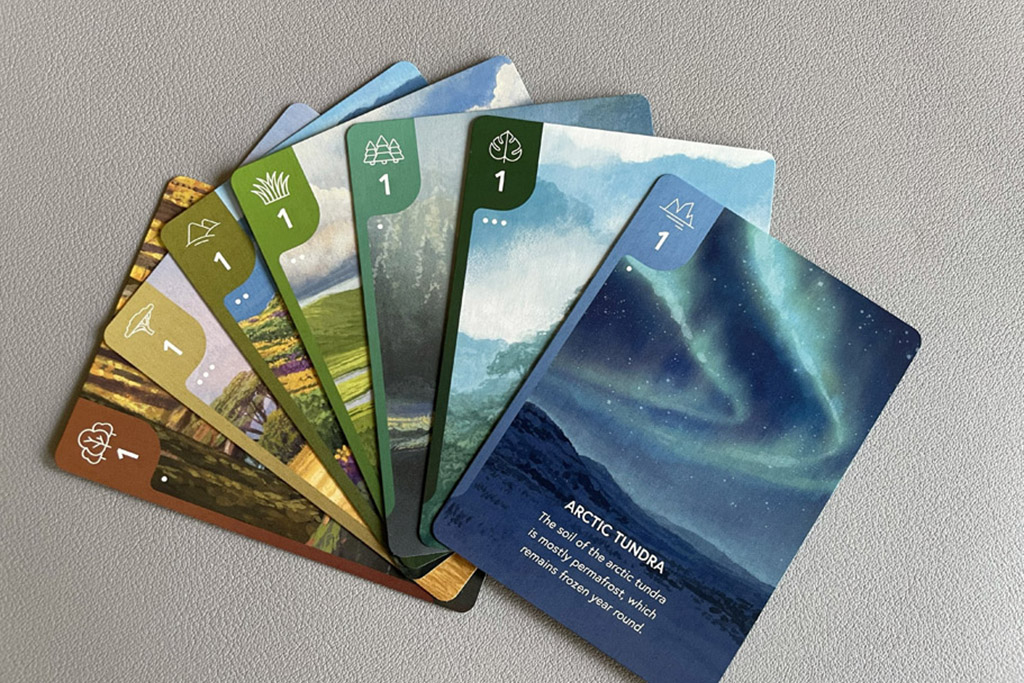
Subastral forces you to manipulate the weather
Play a Card: You must add a card from your hand to a matching cloud.
The Harvest: You then take all cards from a different cloud.
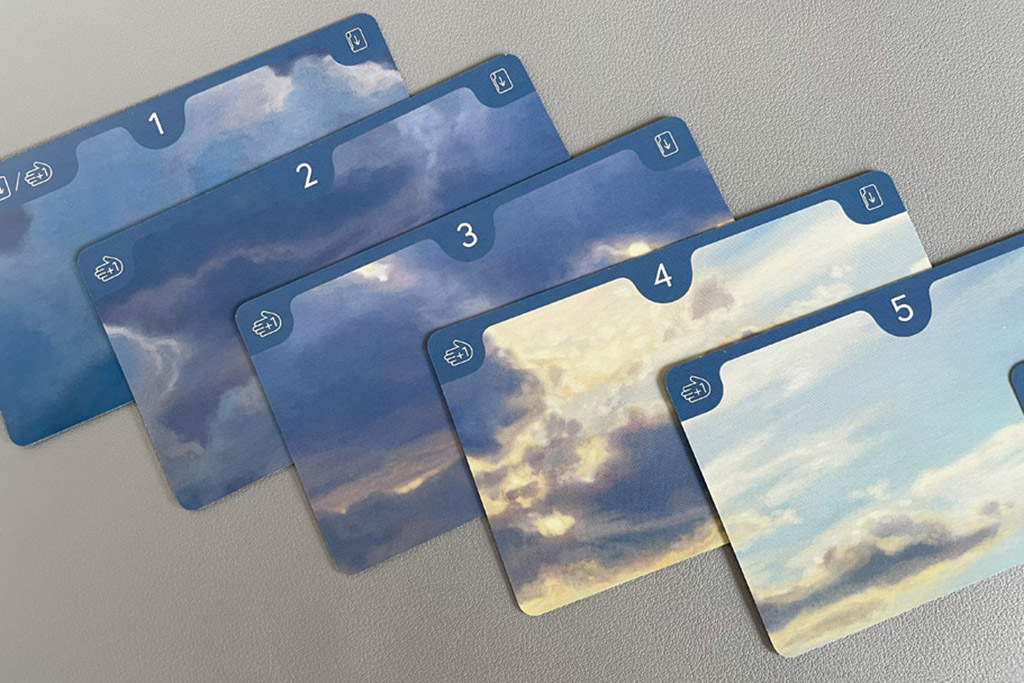
Which cloud determines your reward
To the Left (Toward the Deck): Take the cards into your hand and draw one bonus card from the deck. This is how you fuel future turns.
To the Right (Toward the Sun): Take the cards and commit them to your journal. Once a card enters your journal, it stays there for the rest of the game.
Engineering your Journal
The physical layout of your journal is your engine for victory. As you collect the eight different biomes—ranging from tropical rainforests to arctic tundras—you must place them in a left-to-right order (Pile 1 through Pile 8).
The tension comes from balancing depth and breadth
Mixed Sets (Breadth): You score points for horizontal “rows” of unique biomes. These rows only count as long as they are unbroken starting from Pile 1.
Matching Sets (Depth): You score your two largest piles. The catch? Piles further to the right are worth significantly more points per card.
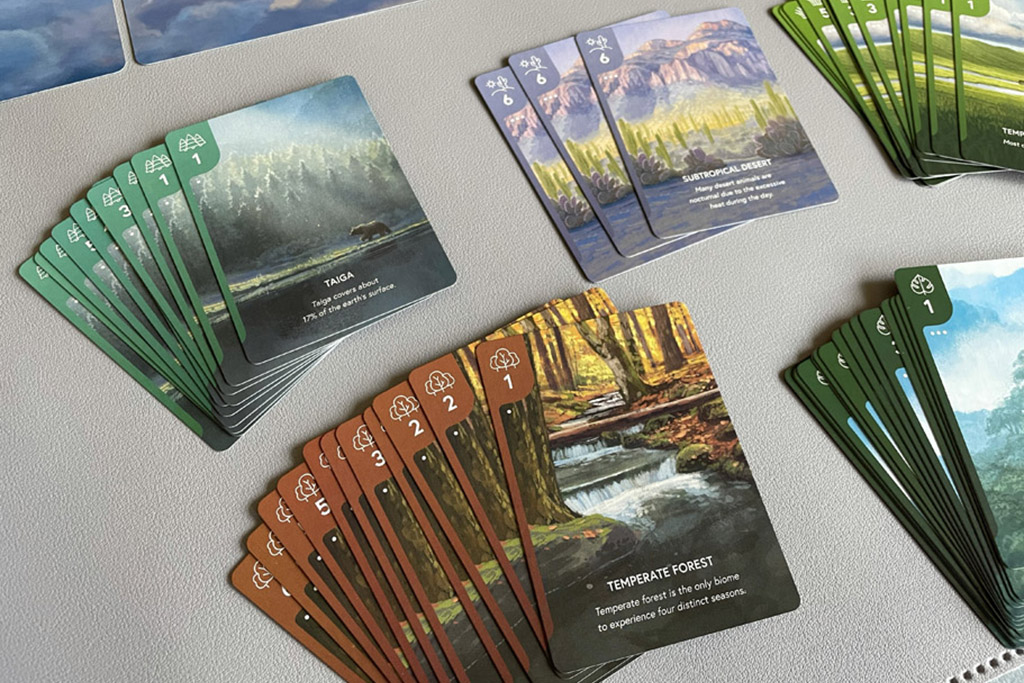
How to Play Subastral
Setup
Prepare the Deck: Remove biome cards that don’t match your player count and shuffle.
The Timer: Insert the “Game End” card by counting cards from the bottom based on player count:
2p: 6 cards | 3p: 9 cards | 4p: 12 cards | 5p: 15 cards
The Cloud Row: Lay out cards #1–#6. Place the deck by #1 and the Sun card by #6. Seed each cloud with one biome card, then add two additional cards to matching numbers.
The Turn Structure
On your turn, perform these three mandatory steps:
Play: Place a card from your hand onto the matching cloud.
Take: Choose a different cloud.
Left of your play: Add to hand + 1 deck draw.
Right of your play: Add to journal.
Edge Case: If you play on #1 or #6 and take from the opposite end, you choose hand or journal.
Refill: Refill the empty cloud. If fewer than two clouds have multiple cards, keep revealing cards until at least two clouds are “boosted.”
Ending the Game
When the Game End card is drawn, players finish the current round so everyone has had an equal number of turns. Then, every player takes one final turn.
Scoring & Victory
Mixed Sets: Score points for unique runs from Pile 1 ().
Matching Sets: Score your two biggest piles. Multiply the number of cards by the pile’s position ().
Tie-breaker: If scores are tied, the player with the fewer total cards in their journal wins (efficiency matters!).
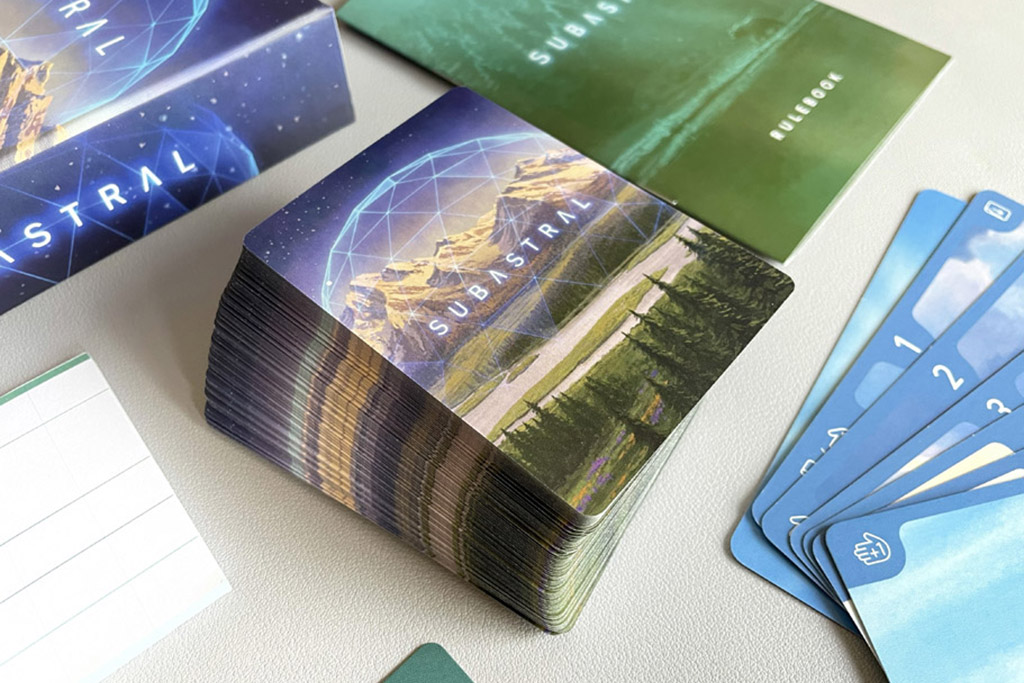
Classic Set Collection Game
Subastral sits near classic set-collection fillers, but it doesn’t draft in a circle or hand you an obvious “best” pick. Its play-a-card / take-a-cloud structure makes every turn a small routing problem: you’re manipulating future availability while also deciding whether today’s haul becomes flexible hand stock or permanent journal placement.