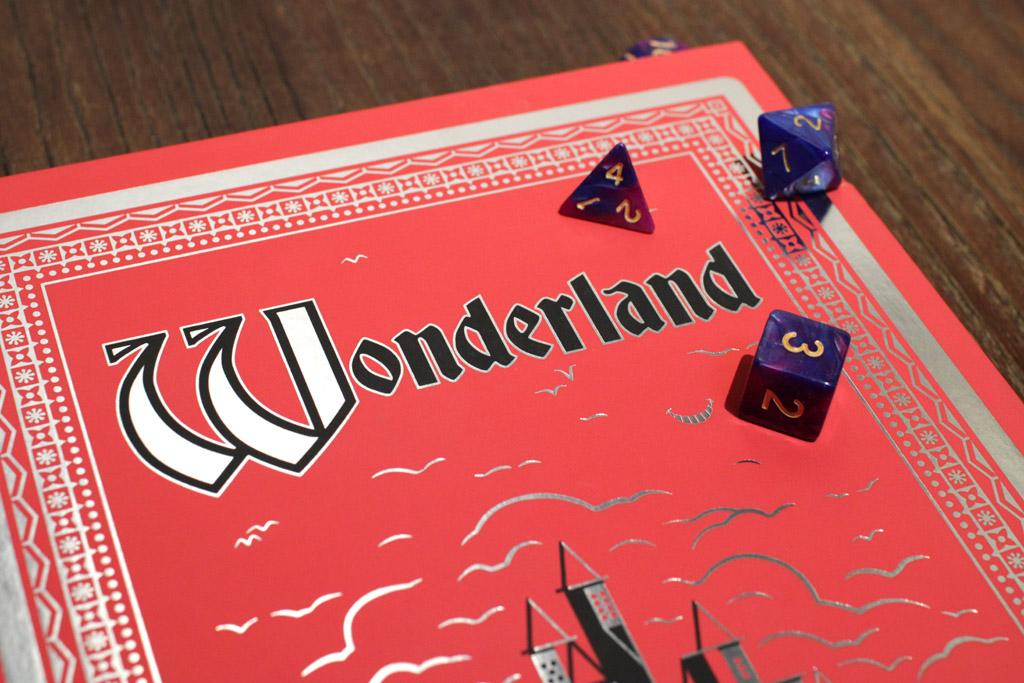
In the landscape of tabletop roleplaying, few settings carry as much cultural weight—and as much potential for terror—as Lewis Carroll’s Victorian dreamscape.Wonderland A Fantasy Role Playing Setting, released on November 12, 2024, bypasses childhood fables entirely. This 224-page tome reimagines the Rabbit Hole as a fractured, lethal megadungeon where logic serves as a weapon and survival remains far from guaranteed.
The visionary force behind this project is Andrew Kolb, an artist, designer, and illustrator who has built a reputation for reimagining classics through a modern lens. Kolb serves as the primary author, illustrator, and book designer. He previously mastered this triple-threat role in his ENNIE Award-winning 2020 release Neverland and his 2022 urban sandbox OZ. His distinct mid-century modern art style defines this book, where clean lines and vibrant palettes mask an atmosphere of deep psychological dread and whimsical danger.
A Megadungeon of Unreason
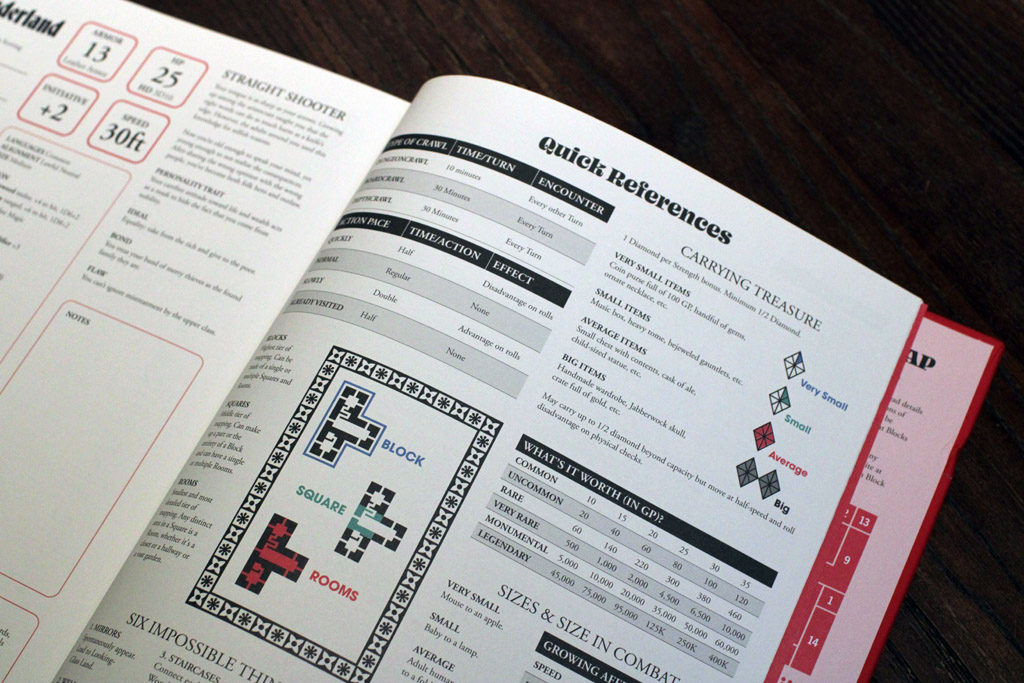
The Wonderland sourcebook commands attention through its physical and graphic design. Kolb employs a “utility-first” philosophy, prioritizing high-speed usability at the table over dense blocks of prose. Information is presented in scannable, data-rich modules, while color-coded tabs and intuitive maps provide the Game Master with a clear roadmap through the dungeon’s complex, overlapping layers. Rather than a passive reference book, Kolb’s design functions as an active engine, driving the narrative forward without slowing down play for rule-searching.
The Mechanics of Whimsical Lethality
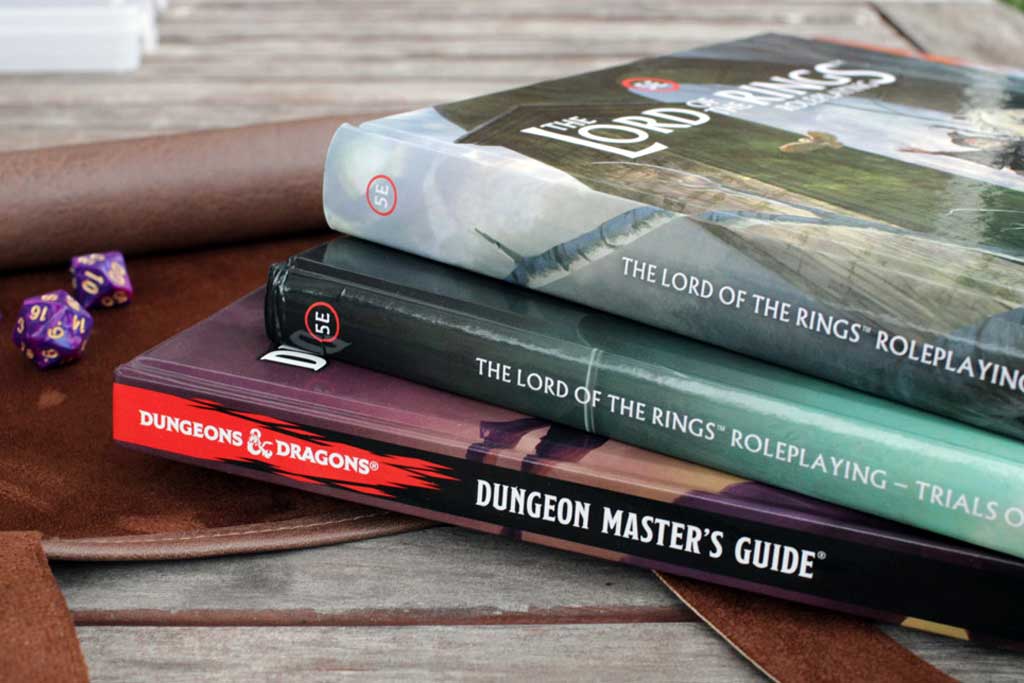
Wonderland functions as a 5th Edition (5e) compatible sourcebook. Unlike standalone systems, it integrates directly into the world’s most popular RPG engine, providing GMs with stat blocks, magic items, and hazards calibrated for 5e characters (typically starting at Level 3).
The book trades traditional wilderness exploration for a massive, multi-level Megadungeon structure. While Neverlandutilized a hexcrawl and OZ a pointcrawl, Kolb specifically designed Wonderland as a combat-driven dungeon crawl. The environment itself acts as the primary antagonist. Kolb introduces environmental hazards that challenge a player’s sanity and hit points in equal measure. In Wonderland, a “Social Encounter” with a talking door can prove just as deadly as a blade, and the book provides GMs with the tools to adjudicate these surreal interactions without breaking the 5e framework.
The Denizens of Wonderland
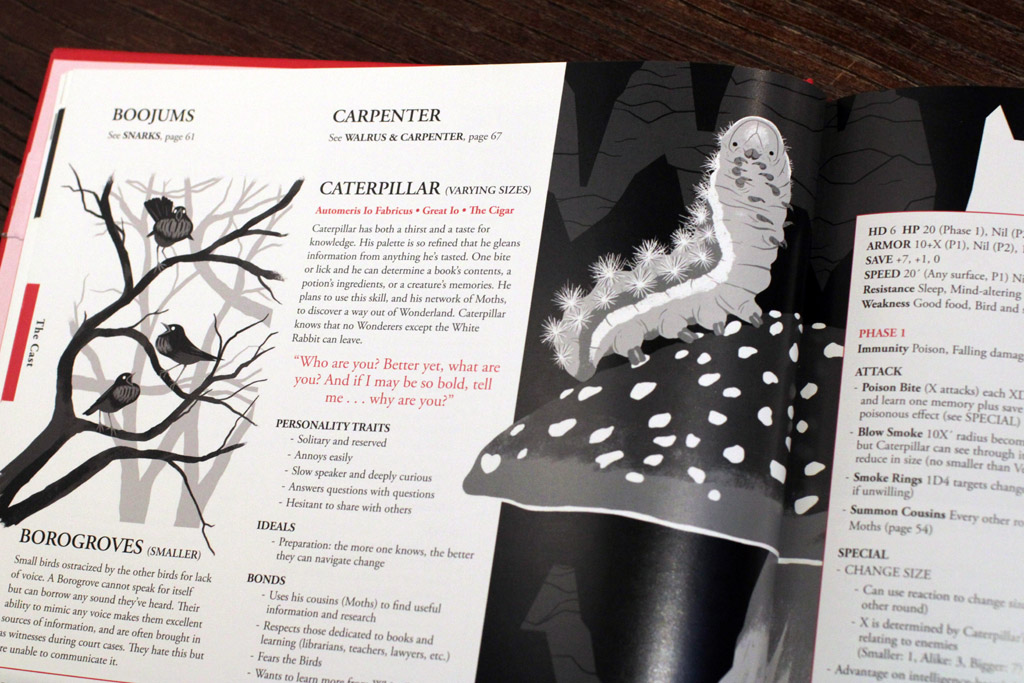
Beyond the shifting architecture, the book populates the Underland with a massive roster of over 100 new stat blocks that breathe life into Carroll’s most famous creations. These aren’t merely fantasy monsters with new names; Kolb reimagines characters like the Mad Hatter, the March Hare, and the White Rabbit as complex entities with conflicting agendas and lethal abilities. The legendary Jabberwock serves as a terrifying pinnacle of the dungeon’s threats, while lesser-known figures like the Walrus and the Carpenter provide opportunities for morally grey social play. Every NPC is designed to subvert player expectations, often rewarding clever dialogue or nonsensical logic over raw physical violence.
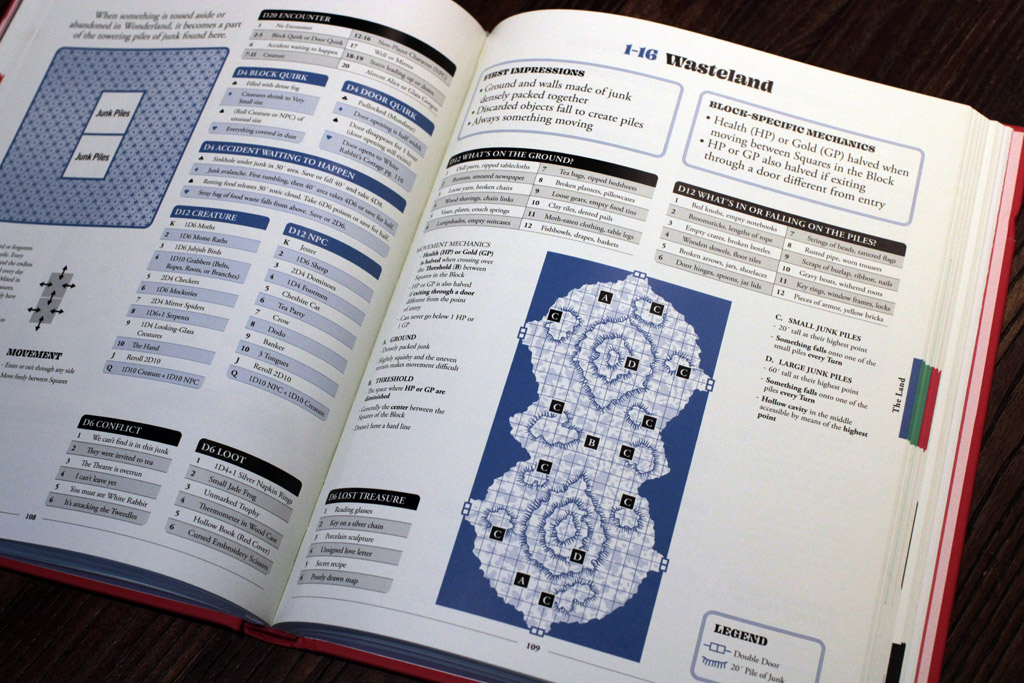
The Setting – A World of Shifting Borders
The heart of the sourcebook provides an exhaustive guide to the “Underland” itself. Kolb divides the dungeon into several “Suites,” each governed by a specific card suit and a distinct flavor of danger.
The heart of the sourcebook provides an exhaustive guide to the “Underland” itself. Kolb reimagines Wonderland as a massive, four-layered megadungeon where each level corresponds to a suit in a deck of cards. As players descend, the atmosphere shifts from rigid bureaucracy to primal, chaotic unmaking.
The Suite of Hearts: The Terror of Authority
The uppermost level serves as the seat of the Queen’s power. This region presents a totalitarian nightmare where “Off with their heads” functions as a literal law of physics. The environment emphasizes absolute, arbitrary authority and suffocating etiquette. Kolb provides detailed floorplans for the Queen’s Castle, where players must navigate shifting social hierarchies and nonsensical legal trials. In this suite, the danger is social and systemic; a faux pas can be just as lethal as a blade.
The Suite of Diamonds: The Greed of Industry
Below the gilded halls of the Hearts lies a realm of cold, calculating materialism. The Suite of Diamonds focuses on the “Business of Wonderland,” characterized by endless mines, clockwork factories, and the hoarding of nonsensical “valuables.” The danger here stems from the mechanical and the transactional. Players encounter constructs and “contractual” traps that demand a high price for passage. It reflects the industrial side of the Victorian era, twisted into a claustrophobic, gear-driven maze.
The Suite of Spades: The Toil of the Earth
The Spades represent the physical labor and the decay of the Underland. This level is a subterranean wilderness of fungal forests, damp tunnels, and forgotten ruins. It is the home of the “working class” denizens who have been discarded or consumed by the suites above. Navigation becomes increasingly difficult as the architecture begins to break down. The horror here is environmental and tactile—players must contend with rot, darkness, and the physical weight of the world pressing down on them.
The Suite of Clubs: The Chaos of the Wild
At the deepest level of the megadungeon, the Suite of Clubs represents the total collapse of logic and the triumph of the primal wild. This is an overgrown, predatory jungle where the flora is as sentient—and as hungry—as the fauna. The “Clubs” correlate to brute force and the unmaking of civilization. Space and time compress here; doors might lead to unexpected vistas or impossible geometries. GMs use specialized encounter tables to generate sensory hallucinations, ensuring that as players reach the bottom of the deck, their grip on 5e’s standard reality finally shatters.
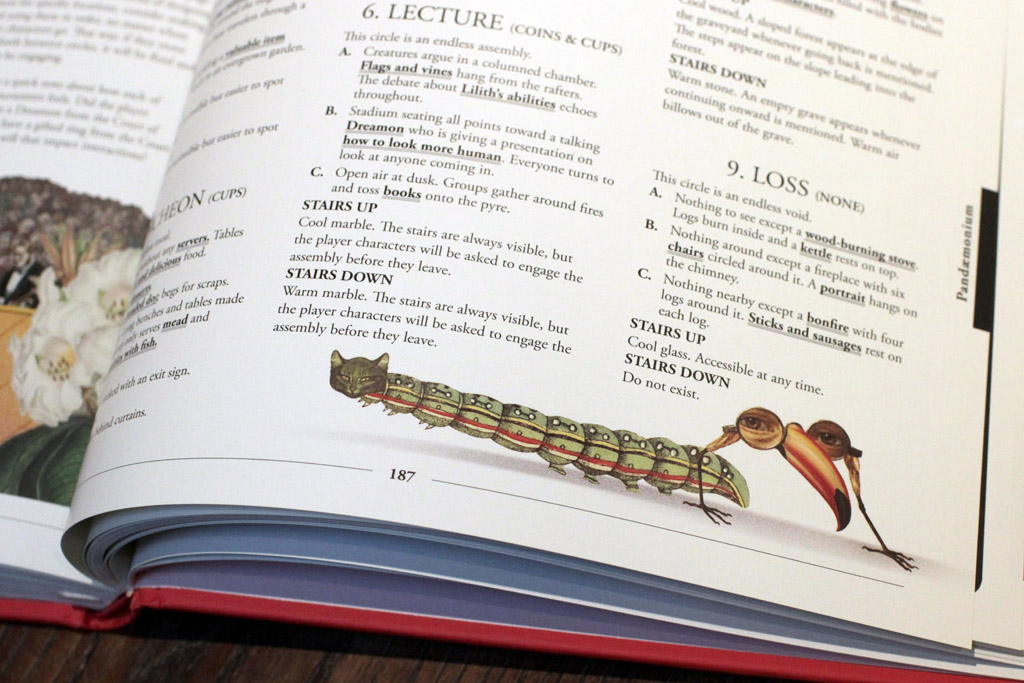
Size, Wordplay, and the Book’s Signature Puzzle Language
Carroll’s most gameable idea has always been scale: doors that mock you, rooms that demand transformation. This book leans into that. Idle Cartulary highlights “size-based puzzles” as a recurring twist—shrinking foes, growing to bypass obstacles, or shrinking to slip through tiny doors. That design choice takes a literary motif and turns it into a dungeon procedure, which fits Kolb’s larger method: translate story logic into repeatable play.
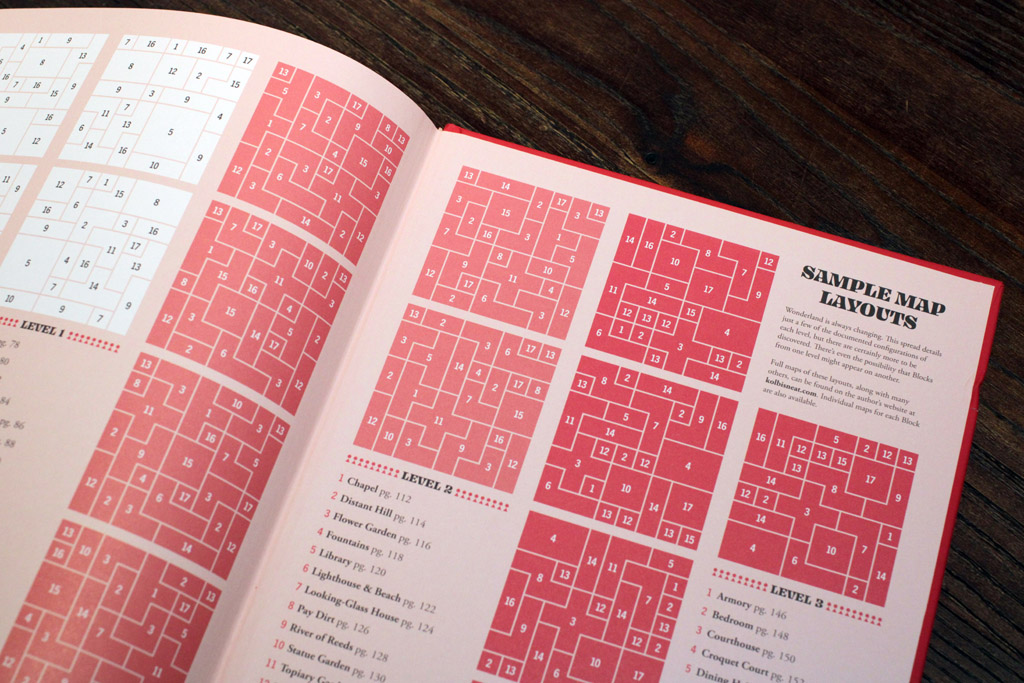
The Value – A Comprehensive Toolkit for GMs
What makes the Wonderland RPG Sourcebook a premier release is its focus on “Low-Prep, High-Impact” play. It functions as a complete toolkit for running a months-long campaign with minimal out-of-session work.
The “Nonsense” of Navigation
The book’s greatest strength is its ability to translate Carroll’s “nonsense logic” into mechanical reality. Kolb provides GMs with prompts for riddles, puzzles requiring non-linear solutions, and traps that play on the expectations of veteran players. This reduces the burden on the GM to “act” wacky, instead letting the mechanics of the dungeon rooms generate the surreal atmosphere.
Integration and Versatility
Because the book is 5e-compatible, GMs can easily drop Wonderland into an existing fantasy campaign as a “hidden realm” or run it as a standalone epic. The infrastructure supports everything from a one-shot descent to a full “Zero-to-Hero” campaign exploring the philosophy of identity.
Quick Stats for Dreamers
Author/Illustrator/Designer: Andrew Kolb
Publisher: Andrews McMeel Publishing
Release Date: November 12, 2024
Page Count: 224 (Full Color)
Core Themes: Megadungeon, Surrealism, 5e Fantasy
System: 5th Edition Compatible